
The Measure of Greatness: Pogačar vs Merkcx
Pogačar Compared to the Legends at the Same Age

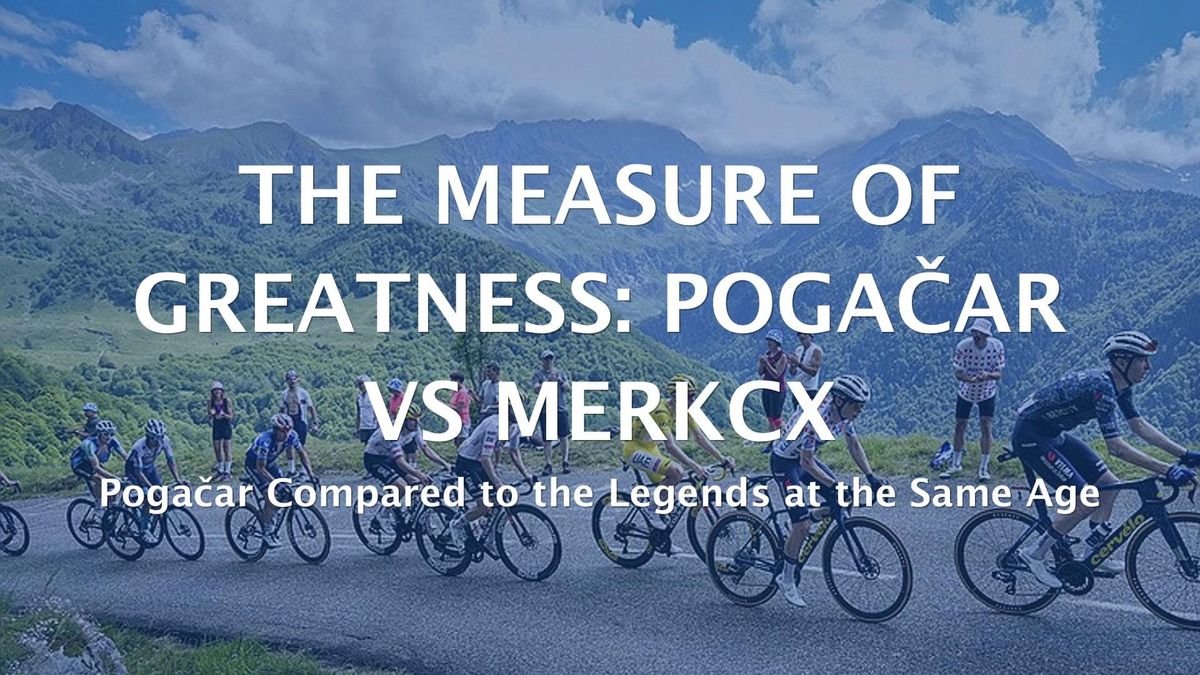
Tadej Pogačar turned 27 in September 2025. It is an age at which most professional cyclists are still finding their ceiling. Pogačar appears to have none.
The question of where he ranks among the sport’s all-time greats is no longer a debate reserved for rainy-day pub arguments. It is an active, urgent conversation — because the numbers are already staggering, and he is still in the early chapters of what his career might become.
By the spring of 2026, Pogačar had collected thirteen Monument victories: five at Il Lombardia, four at Liège–Bastogne–Liège, three at the Tour of Flanders, and one at Milan–San Remo. His Grand Tour record stands at four Tours de France, one Giro d’Italia, and two consecutive World Championship road titles. In 2024 he became only the third male rider in history to complete cycling’s Triple Crown — winning the Giro, the Tour, and the World Championship in a single season. He achieved all of this before turning 28.
Now place Eddy Merckx beside him at the same age. Born in 1945, Merckx was 27 during the 1972 season — a year in which he won his fourth consecutive Tour de France, his third Giro, and set the world hour record in Mexico City. By that point his Grand Tour wins stood at: Tours de France in 1969, 1970, 1971, and 1972; Giros d’Italia in 1968, 1970, and 1972. He had also already claimed Monuments at San Remo, Flanders, Roubaix, and Liège multiple times. The raw numbers at 27 are remarkably close — though Merckx raced a far more congested schedule across far more race days per season.
The Contador comparison is instructive for a different reason. Alberto Contador was a specialist — a pure Grand Tour predator who had little interest in the Spring Classics. He is one of only a handful of riders to have won all three Grand Tours, but his monument record was virtually nonexistent. At 27, Contador had won two Tours de France, one Giro, and one Vuelta. Impressive. But he was playing an entirely different game, one that made no demands on cobbled climbs in Flanders or autumn walls in Lombardy.
Bernard Hinault at 27 — that’s 1981 — had three Tours, one Giro, and one Vuelta to his name, along with victories at Paris–Roubaix and Liège. A formidable record, and one built on Hinault’s signature aggression. But like Contador, Hinault was not yet collecting Monuments with anything like Pogačar’s relentlessness.
What separates Pogačar from every comparable career is the refusal to specialise. In a single spring he won Strade Bianche, Milan–San Remo, and the Tour of Flanders, while also standing on the podium at Paris–Roubaix and Liège. This is not GC rider dabbling in classics. This is total domination across terrain types that historically belong to entirely different breeds of rider.
During Merckx’s peak years between 1969 and 1975, he won approximately 35 percent of every race he entered — a strike rate that has never been approached. Pogačar is not at that level of volume, partly because the modern calendar demands more selectivity and partly because the peloton is deeper and better coached than it was half a century ago. The era matters.
But here is what is undeniable: at 27 years old, Tadej Pogačar has already earned the right to be mentioned in the same sentence as the Cannibal. Whether he eventually passes him is a conversation that still has years — possibly a decade — left to run. The road to greatness is long. Pogačar appears to be riding it at 65 kilometres per hour.