2017 Tour de France Stage 8 Results & Recap

Stage 8 of the 2017 Tour de France is in the books. The final results and standings are below, followed by our recap of how the race unfolded.
Race Recap
Lilian Calmejane takes solo victory on mountainous Tour de France Stage 8
by Evan Hartig
In his first Tour de France, 24-year-old Frenchman Lilian Calmejane (Direct Energie) took an impressive solo victory on Stage 8, distancing Dutchman Robert Gesink (Lotto NL-Jumbo) on the final 12 kilometer climb to Station des Rousses.
“It’s incredible, it’s absolutely amazing,” Calmejane said. “I didn’t expect this on my first Tour, I didn’t think the Tour would smile down on me this soon in my career, it’s wonderful. I’m a bit of a practical joker in the team and I told everyone earlier this morning that I was going to win this stage, but it was really a joke, so the fact that I have come here and won is unbelievable.”
Despite a detrimental quadricep cramp with four kilometers to go, Calmejane crossed the line 37 seconds ahead of second place Gesink. Guillaume Martin of Wanty Groupe-Gobert took third, narrowly holding off the Sky-led peloton charging behind.
It was an explosive day, one for the attackers, on the first high mountain stage of the 2017 Tour de France.
Saturday’s course from Dole to the ski resort of Station des Rousses featured three categorized climbs, the category 3 Col de la Joux at kilometer 102, the category 2 Côte de Viry at kilometer 139, and at the conclusion of the stage, the category 1 Côte de la Combe de Laisia-Les Molunes.
Before the day’s heavy climbing began, the peloton approached the day’s single intermediate sprint still intact at kilometer 45. The sprinters were still present, with the exception of Arnaud Démare, who had detached on the first small ascent 10 kilometers prior to the sprint. Despite a full lead out by Quick-Step Floors, green jersey Marcel Kittel was edged out by André Greipel (Lotto-Soudal) as well as Michael Matthews (Sunweb).
After the intermediate sprint in Montrond, the main selection was made. A group of 46 riders rolled clear and built their margin on the flats prior to the first categorized climb of the day – the Col de la Joux. Sixteen riders went clear from the group of 46 on the first climb.
Robert Gesink (Lotto NL-Jumbo) led the remnants of the day’s breakaway on the final climb, before it split to pieces.
Included was Jan Bakelants and Mathias Frank (AG2R-La Mondiale), Koen de Kort (Trek-Segafredo), Michael Schär and Greg Van Avermaet (BMC), Michael Valgren (Astana), Jens Keukeleire (Orica-Scott), Serge Pauwels (Dimension Data), Matteo Trentin (Quick-Step Floors), Emanuel Buchmann and Marcus Burghardt (Bora-Hansgrohe), Thomas De Gendt (Lotto-Soudal), Warren Barguil and Laurens ten Dam (Sunweb), Lilian Calmejane (Direct Energie) and Alberto Bettiol (Cannondale-Drapac).
Over the summit of the Col de la Joux, Barguil and Pauwels rolled clear from the breakaway of 16. Barguil took the full KOM points atop la Joux.
The lead group of 46 reconvened and began to reshuffle on the descent off the Col de la Joux and into the second climb of the day, the Côte de Viry.
Greg Van Avermaet (BMC), Pauwels, Bakelants and Barguil finally rolled clear and instigated the final move on the descent off the Côte de Viry. They were joined by Nicholas Roche (BMC), Robert Gesink (Lotto NL-Jumbo), Simon Clarke (Cannondale-Drapac), and Calmejane on the lead in to the category one Côte de la Combe de Laisia- Les Molunes – the final ascent of the day.\n“The plan was to try and get Greg Van Avermaet in the breakaway hoping that it would be less of a climbers’ group and he could play his card in the finish,” Roche said. “The race went bananas and there was a group of 45 riders so we had to have numbers there as we didn’t want to get caught like we did in the Dauphine. We learned there that it is easier to have riders drop back than try and bridge across. So we tried to ride aggressively and keep the race going.”
Back in the peloton, on the descent off the Côte de Viry, Chris Froome and teammate Geraint Thomas overshot a corner despite Sky’s organization at the front. Thomas took a tumble but the yellow jersey of Froome was able to keep it upright. The pace of the field slowed as they made their way back to their designated spot within their enclave at the front.
“I’d just got up to the front and the boys went in [to the corner] a bit hot. I just looked back and obviously I was a second late to start braking and – off the road. It’s kind of like ‘Do you go down into the woods, or hit the hay bale?’ So I hit the hay bale and just flipped over the bars. Luckily I was straight back up and it was fine.”
Ninety seconds up the road, there was immediately aggression within the breakaway at the base of the 12 kilometer Côte de la Combe de Laisia-Les Molunes.
Barguil was the first to accelerate, and his pace detached Van Avermaet and Clarke. Bakelants was the next to go after a counter-move by Pauwels.
With eight kilometers to the summit, Roche attacked the remaining five in the breakaway. Pauwels accelerated and began to claw his way up to Roche as Barguil, after 100 kilometers out front, finally cracked.
With six kilometers to the summit, there were four riders remaining. Calmejane sensed an ease in the pace, rose out of the saddle, and accelerated. With a grimace, he immediately distanced himself from the remaining three. Gesink, in true form, slowly pulled away from Pauwels and Roche, and the chase was on.\n“I went really deep,” Roche said. “Once I was up in that group there was two possibilities; one, I really wanted to make it to the top in case Richie was isolated from the chasing group and two; in the case that we arrive, I would give it a go. I really gave it everything.”
Calmejane, taking KOM points over the summit of the Côte de la Combe de Laisia- Les Molunes, still had 12 kilometers of rolling terrain to the finish at Station des Rousses. Thirty seconds was his margin over Gesink, and he looked strong and steady until he faltered with a quadricep cramp at six kilometers out.
Calmejane was able to overcome the pain, however, and continued on ahead of Gesink for the win. Thrilled despite the physical suffering, he took his first Tour de France stage by 37 seconds as he fell off his bike upon crossing the line, legs disabled with cramps.
“It’s more than a dream, to win up here on my own, it’s just wonderful,” Calmejane said. “I had a few problems on the last climb. It was a shorter day today, an amazing stage and very difficult. There was a lot of attacking going on and at the end I had to be strong, I suddenly found myself missing some energy.”
Gesink could only acknowledge that the best rider had won.
“It was crazy from the inside … it was really hard to catch the right group, and that cost a lot of power and energy,” the Dutchman said. “In the end it was a strong group, and I tried to play my own game and yeah, I exploded a little bit trying to bridge towards the first and second … I’m proud of what I did, I did what I could and I have to be satisfied with the result. There are more chances coming up so we’ll see.”
Link: https://cyclingtips.com/2017/07/lilian-calmejane-takes-solo-victory-mountainous-tour-de-france-stage-8/
___________________________
Carnage on Mont du Chat? Tour’s Stage 9 set to ‘blow GC wide open’
by Matt de Neef
STATION DES ROUSSES, France (CT) – It’s not a mountain-top finish, but there’s every chance that stage 9 of the 2017 Tour de France will be among the most decisive of the entire race. With seven categorised climbs and more than 4,000 vertical metres of climbing, there’s little doubt it’s among the Tour’s most challenging stages, if not the toughest.
Of the day’s seven climbs, three have the highest possible difficulty rating due to their punishing gradient: the Col de la Biche (10.5km at 9%), the Grand Colombier (8.5km at 9.9%), and the Mont du Chat (8.7km at 10.3%).
It’s the last of those, the day’s final climb, that will be a focal point tomorrow. As race leader Chris Froome notes, the Mont du Chat is challenging enough on its own, but coming at the end of a long hard day increases the difficulty significantly.
“I think given where Mont [du] Chat is in the stage, coming after four big climbs already, and especially after the stage we just had today, I think it could be a very decisive climb at the Tour,” Froome said. “When you’re climbing, most of the time the gradient is around 10% [and it’s] not a short climb either — it takes over half an hour to get up there …
“It’s really going to quite selective — I imagine it’s going to blow the general classification wide open.”
The Mont du Chat featured on stage 6 of the Criterium du Dauphine last month, but the stage was easier than stage 9 of the Tour will be.
It’s not the first time the professional peloton has raced up the Mont du Chat this year. Stage 6 of last months’s Criterium du Dauphine took the riders up the climb before a hair-raising descent to the finish in La Motte-Servolex. On that day, the Mont du Chat wreaked havoc. It was there that the breakaway’s three-minute advantage was quickly eroded, and that the peloton was thinned down to just four potential stage winners.
The day was won by Jakob Fuglsang (Astana), the Dane outsprinting Richie Porte (BMC), Froome, and teammate Fabio Aru on his way to overall victory in the race. Fuglsang told CyclingTips at the end of today’s stage 8 of the Tour de France that he expects tomorrow’s stage to unfold differently to stage 6 of the Dauphine.
“I think the Mont du Chat: we’re not going to come [as] such a big group as in the Dauphine,” Fuglsang said. “It’s going to be a different race because of the two climbs before. I think it’s going to be a completely different race and a stage where it’s going to be a bit like today — maybe just that there will be no breakaway; just a bunch that’s riding full gas the whole day.”
While not as hard as tomorrow, today’s stage 8 was far from easy. A strong breakaway got up the road, with several would-be GC contenders in their midst. To protect the yellow jersey, Team Sky rode a hard tempo on the front of the peloton all day, ensuring a challenging stage for all in tow. That effort is certain to have an impact tomorrow.
“Tomorrow’s going to be a monster stage, especially after the stage we had today,” Froome said. “That was already a really tough stage today and I think there’s going to be some tired legs. I expect there to be some really big gaps in the general classification after tomorrow’s stage.”
Tomorrow’s stage doesn’t end at the top of the Mont du Chat — rather, it’s 26km from the summit to the finish in Chambéry. The first half of that comprises the road off the Mont du Chat; a very narrow, technical descent that made for thrilling albeit nerve-wracking viewing during the Criterium du Dauphine.
While Froome attacked Porte and Fuglsang on that descent in the Dauphine, the gap he opened was ultimately short-lived. Speaking today, the three-time Tour winner said he sees the descent off the Mont du Chat as something of a post-script to the real challenge of tomorrow’s stage.
“It’s a fast descent; it’s a fast, tricky descent, but in my opinion it’s more about the climb tomorrow,” Froome said. “That climb is savage, especially coming quite late in the race.”
Irishman Dan Martin (QuickStep Floors), who currently sits fourth overall, offers a similar analysis.
“People point out that it is downhill and then flat to the finish after the last climb, but if you are not in the front group, if you are the one who gets dropped, you could lose minutes,” Martin told CyclingTips after stage 7. “On mountain top finishes, even if you are having a bad day you can still limit your losses to a minute. But if you are isolated on your own on the top of the last climb and there are a group of four or five riders in front willing to work together, in that 25 kilometres to the finish you can definitely lose two or three minutes.”
While the climb will almost certainly cause carnage in the bunch, the challenge of the Mont du Chat descent shouldn’t be discounted. At the time of writing the weather forecast suggests rain for stage 9. Should that come to fruition, it could change the complexion of the stage completely. An already challenging descent would be made treacherous, particularly for those pushing the limits of their ability to stay clear of or catch their rivals.
“If we do get rain and hail, that’s definitely going to have some impact on the race for sure,” Froome said.
The technical descent off the final climb of stage 9 of the Tour shouldn’t be discounted, particularly if it’s wet.
While stage 6 of the Criterium du Dauphine finished just two kilometres after the Mont du Chat descent, tomorrow’s stage of the Tour is different. Once off the mountain it’s a relatively flat 13.5km to the finish line in Chambéry. While the climb is likely to be the stage’s most decisive point, and while the descent is a not-insignificant challenge in it’s own right, these final flat kilometres shouldn’t be ignored either.
The terrain will suit a larger group, meaning it will be hard to catch a bunch of any decent size that gets to the bottom together. Equally, a chasing group will have an advantage in those final kilometres should it be a single rider or handful of riders in the lead. Of course, both scenarios assume an element of cohesion in such a group.
So, who does stage 9 favour? For a start, it’s worth mentioning that of the four riders that contested the finish on stage 6 of the Dauphine, three are currently in the top five on GC at the Tour de France — Froome, Aru and Porte. More generally though, the winner will have to be an exemplary climber, a courageous and technically gifted descender, strong on the flatlands, a rider with great endurance and ability to recover, and, potentially, a rider with a strong kick after a long, hard day in the mountains.
In many ways, it will be the perfect test to see who’s the most well-rounded rider at the 2017 Tour de France. And with so few opportunities for the GC riders at this year’s race, and with stage 9 being the last before the first rest day, there’s really no reason for any of the contenders to hold back.
Link: https://cyclingtips.com/2017/07/carnage-mont-du-chat-stage-9-tour-set-blow-gc-wide-open/
____________________________
Three decades after Roche’s win, Dan Martin targeting another Irish Tour de France podium
by Shane Stokes
When the Tour de France got underway in Germany last Saturday, Dan Martin had numerous reasons to be motivated. His ninth place last year was one. His strong season was another. Results such as third overall in Paris-Nice, second in both Flèche Wallonne and Liège-Bastogne-Liège, plus third in the recent Critérium du Dauphiné showed him he was on a career-best run of form.
But there was another factor that fired him up. The last time the race started in Germany, a full 30 years ago, an Irishman started amongst the favourites and went on to win the race.
The anniversary of his uncle Stephen Roche’s success was something that was very much on Martin’s mind, ramping up his motivation even further.
“Obviously the Tour is unpredictable, a lot can happen,” he told CyclingTips prior to the start. “But I think barring bad luck and race circumstances, I definitely have the potential to improve on last year’s result.”
He wasn’t thinking of eighth or seventh or sixth. “Why not finish on the podium?” he said, putting it out there. “It would be incredible, especially 30 years on from Stephen’s achievement, to get as far as that podium in Paris.”
That may sound to some like the usual pre-race optimism – why not aim high? – but since then things have gone fully to plan. He’s avoided any mishap, steered clear of trouble and, in the first two uphill finishes, succeeded in gaining time on every GC rider save for Fabio Aru (Astana). He’s now sitting fourth overall heading into the big mountain stages.
There’s a long way to go to Paris, but each passing day inches Martin closer to that podium goal.
Taking a less impulsive approach
Martin’s ninth last year was his first time to take a top ten GC result in the Tour, but he’d shown his ability before. Past results include stage wins in the Vuelta a España (2011) and the Tour de France (2013), plus victories in the Liège-Bastogne-Liège (2013) and Il Lombardia (2014) Classics.
Athletic ability passes down mostly via maternal DNA and it seemed that, via his mother Maria, he’d inherited much of the same talent as uncle Stephen.
Martin also has a fastidious approach to the sport, pushing himself continuously. He had never finished in the top ten of the Tour before, tending to become ill in the final week. However that changed 12 months ago. He took second, fourth and sixth on stages en route to ninth overall, and believes he would have been higher up with different setup of his equipment.
“I am a bit full of regrets, because I know if I had my time trial bike set up the way it is now last year, I definitely would have been close to the podium,” he said. “I have made that much improvement.”
But bike setup aside, different tactics would also have closed the gap. On several occasions in 2016 he attacked early on during the final climb, but was hauled back and then gapped by the main GC riders.
The kind of surprise surges that won him the 2010 Tour of Poland are less likely to succeed in the French event.
“I know how to race the Tour de France now,” he said, accepting that different tactics would have been better. “I have never raced the Tour de France in the front before like that. And now I know it is different to the Vuelta.
“In the Vuelta those attacks that I did would have worked. And in this year’s Dauphine they worked, because it is a lot more open racing.”
So what’s the different between those races and the Tour?
He believes it is because far more is at stake.
“People don’t [take chances to] try to win the Tour de France,” he explained. “They try not to lose what they have got. They try to protect their fifth or sixth or seventh or eighth in general classification. But nobody rides for eighth in general classification in any other race of the year.”
Or, to put it another way: a solid performance in the Tour de France is vital for sponsors and teams, making them far more cagey about risky attacks.
“Here people race differently. But I know that now,” he said. “And I have learned a lot from last year. I think tactically I am a lot more calm, and that comes with confidence as well. I am a bit more calculating in the way I am riding. Hopefully that doesn’t mean more boring, but in the end it hopefully leads to better results.”
“I’ve never felt stronger going into the Tour”
Martin’s belief that he could podium in the Tour grew in the Critérium du Dauphiné. He was 32nd after day two, then improved to 28th, then 18th, then seventh, slipped to eighth on the penultimate day and then jumped to third overall by the end.
He was also second on the final stage, taking the runner-up slot behind stage victor and surprise overall winner Jacob Fuglsang of Astana.
Although he had also finished third overall 12 months ago, he said that the result this time around was more significant.
“The Dauphine was unexpected,” he said prior to the Tour start. “Similar to last year, everything had gone pretty well beforehand. But I had really held back in training. I hadn’t done any intensity. I just rode there to let the race do its job, as far as picking the form up.
“The legs were good there and, afterwards, I seem to have got even better. I have never felt stronger going into the Tour de France.”
The race got off to a solid start in Dusseldorf. Martin is a climber rather than a time trialist but, in finishing 57th, 49 seconds back, he kept in touch with the other GC contenders.
“In the end I was happy with my ride,” he told CyclingTips. “The weather conditions were far from ideal and also I had a problem with my TT bike before the start. So that was a very stressful moment. The same bike that I had used in Dauphine had suddenly become illegal.
“It was bizarre. It seems to depend on how the [UCI] jig is set up. We didn’t really understand it, but we only had to make a very, very small change.
“I did a good performance in the time trial. I think I could have maybe been a little bit better if I had taken more risks in the corners. But it is the first day of the Tour de France, and it is better to finish with your skin on.
“I didn’t lose any time to the main competitors. Only to Chris [Froome], really. So it was a good start for me.”
His team got a boost on stage two with the stage victory of Marcel Kittel, and then on stage three Martin went agonizingly close to a stage win. He was best of the GC contenders on the climb to the finish at Longwy, but the ramp wasn’t steep enough to see off the sprinters.
“I think in the end I effectively sprinted the last 600 metres,” he said. “It was just keeping momentum the whole time. Obviously I am never going to beat Sagan in a straight drag race. But I was obviously very happy to get third and to be sprinting against those guys. I would never have imagined it, it was very special.”
Going up against world champion Peter Sagan (Bora-hansgrohe) and Michael Matthews (Team Sunweb) on stage three.
“I’m just in a very good place in my life at the moment”
Following that third place on day three, Martin avoided the chaos at the end of the next stage. Two separate crashes happened in the final kilometre, with a tangle between Peter Sagan and Mark Cavendish causing the latter to hit the ground, to break his shoulder blade and to have to leave the race.
Day five was more his terrain, and on the final climb to La Planche des Belles Filles he was one of the very best. Fabio Aru (Astana) attacked early on and got a gap he was able to build on all the way to the finish. Martin had planned to leave things for a sprint, and believed that others would get Aru back.
“With BMC riding all day, I thought that maybe Richie would have gone after Aru. [When he didn’t], I thought that Sky were really going to put the hammer down and chase him down on the flat section.
“But in the end we kind of all looked at each other. Chris attacked and we were on his wheel. Then I tried to go and continue the movement as we had dropped a lot of the other guys. In the end we just kind of looked at each other again, and it was a case of everybody coming back for the final sprint to the line.”
In that sprint, Martin gapped Froome, Porte and the others, netting second on the stage and jumping up to fourth overall. Starting stage eight to Station des Rousses, he was just 25 seconds behind Froome, 13 behind Froome’s Sky teammate Geraint Thomas and 11 behind Aru.
“I’m definitely going better than last year,” he said. “I knew coming into this race that I had stepped up a level this year.”
So what have been the factors behind that?
“I think we already saw an improvement last year,” he answered, “just from my team circumstances. But I also learned a lot last year. I am just learning all the time, and the new team environment definitely helps with that. I learned what I need to do to really race well.
“I think another year of living in Andorra and learning how that training affects me has also been a factor. I’m that age as well [he is 30, an age around the time when Grand Tour riders peak]. I am maturing psychologically as well as physically.
“And I think the team also helps with that. There’s this belief. There’s no pressure. I go into races with this…you know you have got a strong team behind you, and you have got guys who are getting results everywhere. So you haven’t got this pressure to get results all the time.
“That said, it is not that I can’t deal with the pressure. It is more that it is a confidence going into every race. Every race, we go there trying to make the results and we believe that we can get a result. That is the difference. It is an environment that suits me very well and it has definitely led to this progression.”
There is one more factor too, something far away from competition. “I got married to my wife Jess last October. I am just in a very good place in my life at the moment, and that is showing in how I am racing.”
Looking to the upcoming stages, Martin believes Saturday and Sunday’s stages could be the hardest of the Tour. The soaring heat, heavy roads and the cluster of climbs on both days will all pummel the riders and reward those who are strong.
Of the two, he says Sunday will likely be more decisive.
“I think it is going to be completely brutal,” he told CyclingTips on Friday, about an hour after Kittel took his third stage win. “It could be the hardest day of the Tour.
“There are some really difficult climbs and then the possibility to lose a lot of time afterwards as well. People point out that it is downhill and then flat to the finish after the last climb [the Mont du Chat], but if you are not in the front group, if you are the one who gets dropped, you could lose minutes.
“On mountain top finishes, even if you are having a bad day you can still limit your losses to a minute. But if you are isolated on your own on the top of the last climb and there are a group of four or five riders in front willing to work together, in that 25 kilometres to the finish you can definitely lose two or three minutes.”
Confidence high, Martin is counting on gaining rather than losing. If he’s got the same legs as on stage five, he will seek to push forward on the climb and be sparking off moves rather than responding to him.
Much like his uncle 30 years ago, he will look for every opportunity to gain time and to move ever-closer to that podium he is seeking in Paris.
Link: https://cyclingtips.com/2017/07/three-decades-dan-martin-targeting-second-irish-tour-de-france-podium-paris/\n
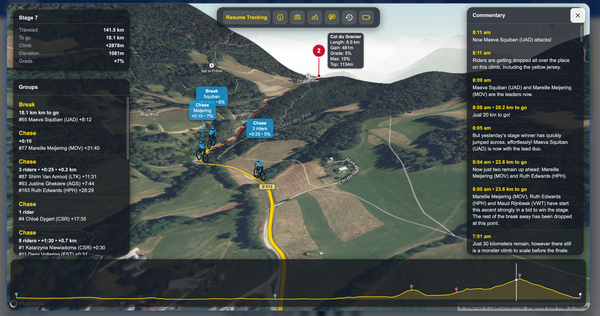
Get our full coverage of the Tour de France and every race we cover with our mobile app! The apps have over 100 additional exclusive features, including our award-winning Time Machine feature that lets you pause/rewind/replay the entire app to sync with delayed race video, integrated Fantasy Cycling, push notifications, an integrated news feed, live GPS tracking, world-class commentary, and our animated interactive maps and profiles.