Six Shooters

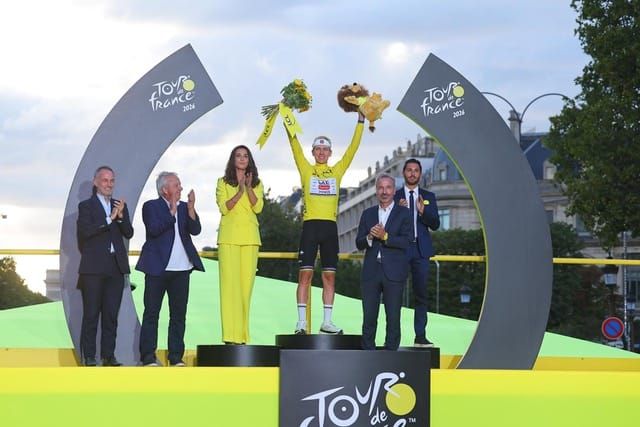
Going into the Tour de France, it looked like Tadej Pogačar would be pushed very hard as he attempted to defend his title and join the exclusive club of five-time winners. Yet, just half a dozen stages into the race the Slovenian world champion had torpedoed his rivals’ hopes of mounting a sustained challenge, and the next fortnight looked set to be a very long haul indeed.
Fortunately for fans, the many sub-plots that emerged during those two weeks, and especially the final one, meant that the 2026 edition didn’t become humdrum. Pogačar played a role in this by not dominating when he could have done, but the thrills were mostly delivered by others, notably Mathieu van der Poel, Mauro Schmid, Remco Evenepoel and Richard Carapaz.
Particular mention should also be made of Mads Pedersen, who served up what was arguably the most enthralling contest ever for the green jersey, compensating for his lack of pure sprinting speed with a focus on intermediate sprints that was mind-bogglingly impressive. It was entirely fitted that the Dane wrapped up the points competition after making two attacks on the super-category Col de la Croix de Fer – the first to reach the yellow jersey group, the second to leave it and bridge across to the break – so that he could win the sprint that followed the crossing of that mighty pass.
That stage was the penultimate of a final quartet that will live long in the memory and which concluded with Van der Poel’s defeat of Pogačar on the Champs-Elysées. Like last year’s Paris loss to Wout van Aert, it showed that the UAE team leader can be beaten when he wants to win, albeit with 20 days of relentlessly intense Grand Tour racing in his legs.
Across the race as a whole, however, there wasn’t the slightest indication that Pogačar might be challenged, let alone beaten, in a three-week stage race. Given his relatively light racing schedule earlier in the season, I expect him to take advantage of his current form and his lack of realistic challengers to prove that again at the Vuelta during late August and early September, thereby completing the set of Grand Tour titles.
I’d also be surprised if he doesn’t go on to become the first rider to win six Tour titles next summer. Yet, rather than speculate on what may happen in 2027, it’s more instructive to look back and see why the other members of the five-time Tour winners’ club didn’t capture another yellow jersey.
For Jacques Anquetil, the barrier to a sixth title was not having unquestioned leadership of the French national team in the wake of his first victory in 1957. He had to share leadership with three-time champion Louison Bobet in 1958, which didn’t suit either of them. A year later, the French again lined up with this pair and added Roger Rivière and Raphael Geminiani to the volatile mix. In 1960, Anquetil missed the Tour completely, having opted to focus on winning the Giro.
It wasn’t until 1961 that national coach Marcel Bidot agreed to build a team around Anquetil, who duly won his second Tour. When trade teams replaced national teams in 1962, the Norman became the standard-bearer of the Saint-Raphael team and added three more titles. He could have chased a sixth in 1965, but focused instead on chasing an unprecedented double at the Critérium du Dauphiné and Bordeaux-Paris, the latter taking place the day after the former finished. While Anquetil attained that goal, his achievement now stands out as an indicator of the lost status of those two events.
Eddy Merckx’s pursuit of Tour glory began even more slowly than Anquetil’s. Initially regarded as a Classics rider, his leadership of an Italian trade team led to him lining up at the Giro three times before he made his Tour debut. After winning four on the trot, he sat out the 1973 race to complete the Vuelta-Giro double, an astonishing feat as they ran virtually back to back at that time. He returned to the Tour in 1974, clinching a fifth title.
Merckx was on course to claim Tour number six in 1975 until he was waylaid by a punch from a fan on the Puy de Dôme, a crash that left him with a broken cheekbone and the brilliance of Bernard Thévenet in the high mountains, where the Belgian was always most likely to come unstuck. He finished that race as runner-up. Though only 30, he never finished on another Grand Tour podium.
The absence of a sixth Tour from Bernard Hinault’s roll of honour was down to a knee injury that forced him out of the 1980 race when well on course to a third consecutive success. A flare-up of the same injury prevented him from starting the 1983 edition, won by the young Laurent Fignon. Demolished by the peerless Fignon in 1984, he bounced back to claim his fifth title in 1985, helped by teammate Greg LeMond. The pair swapped roles in 1986, the American took the title and Hinault finished second in what was his final race before retirement.
Miguel Induráin’s lack of a sixth Tour crowns stems in part from his Banesto team’s decision to delay his promotion to leader as the replacement for Pedro Delgado until 1991. Going into the 1996 race with five consecutive victories behind him, the Spaniard looked almost as impregnable as Merckx was in 1975 and Pogačar does now. His Thévenet was Dane Bjarne Riis, who subsequently admitted to doping.
Pogačar shares similarities with all of this illustrious quartet, but significant differences too. He’ll be 28 going into next year’s race when he’ll be chasing a sixth yellow jersey, two years younger than any of them. He’ll also have far fewer Grand Tours under his belt, a consequence of the Tour’s elevation in status and his absolute focus on it.
Inevitably, a stronger rider will emerge, a modern-day Thévenet who might also be French. That reordering of the racing hierarchy could happen next year due to form or misfortune. For now, though, this is still Pogačar’s world and I don’t expect any distraction from his pursuit of a sixth Tour title.
Peter Cossins