2017 Tour de France Stage 7 Results & Recap

Stage 7 of the 2017 Tour de France is in the books. The final results and standings are below, followed by our recap of how the race unfolded.
Race Recap
Marcel Kittel narrowly three-peats on Stage 7 of Tour de France
by Evan Hartig
It was another day for the sprinters Friday on Stage 7 of the Tour de France, with Marcel Kittel (Quick-Step Floors) taking the win by an almost negligible margin over Edvald Boasson Hagen (Dimension Data). Michael Matthews of Sunweb was third on the day into Nuits-Saint-Georges.
“I really had no clue if I would have won it or not,” Kittel said. “On the finish line I thought this is going to be close. [On the bike throw] I tried to make myself three metres longer. At 150 metres to go, I was on Boasson Hagen’s wheel, we came around that [righthand] corner, and I thought it was 200 metres more, when it was much less. Then I knew I had to pray the door was open on the right side so I could pass him, and it was just enough.”
Maxime Bouet of Fortuneo-Oscaro was the first aggressor of the day from the moment Christian Prudhomme’s neutral flag dropped. Following him was Manuele Mori (UAE Emirates), Yohann Gène (Direct Energie) and Dylan van Baarle (Cannondale-Drapac). Their margin rose to just under two minutes by kilometer three, but they’d be kept on a short leash by the teams behind.
As with Thursday, Julien Vermote of Quick-Step Floors took the front of the field behind and asserted himself as the primary determiner of the time margin.
The four men would have their work cut out for them. Despite a flat profile, the wind was blowing strongly on the roads through vineyards on the 213km route from Troyes to Nuits-Saint-Georges.
The only intermediate sprint of the day came at 108 kilometers in Chanceaux. The breakaway was the first to reach it, with Bouet jumping early, attempting to claim maximum points. Mori jumped with Bouet, however, and overcame him right at the line.
In the field 1:40 behind, the battle for the green jersey continued. Six riders distanced themselves from the peloton to contest for the remaining sprint points. Sonny Colbrelli (Bahrain-Merida) triumphed, taking 11 points, with Alexander Kristoff (Katusha-Alpecin) taking 10. André Greipel was third across the line for nine points. Despite not contesting today’s intermediate sprint, Kittel took the lead in the green jersey points competition, ahead of Frenchman Arnaud Démare (FDJ).
The only climb of a day, the category four Côte d’Urcy, came at 148 kilometers. Maxime Bouet took the point from the breakaway.
The day’s breakaway consisted of Dylan van Baarle (Cannondale-Drapac), Maxime Bouet (Fortuneo-Oscaro), Manuele Mori (UAE Emirates), and Yohann Gène (Direct Energie) on Stage 7 from Troyes to Nuits-Saint-Georges.
With 42 kilometers remaining, the fight for position commenced back in the field. A technical entry into the town of Gilly-lès-Cîteaux was directly followed by an exposed section of road with a hard crosswind. Sky imposed themselves at the front of the field and accelerated, stringing out the field on the narrow roads.
After the acceleration in the peloton, the breakaway’s margin decreased to under a minute. Team vehicles were removed from the gap and it looked to be an early conclusion for the men out front.
Team Sky protected Chris Froome on Stage 7 from Troyes to Nuits-Saint-Georges.
Philippe Gilbert led the men of Quick-Step Floors to the front with 12 kilometers remaining. Kristoff’s Katusha-Alpecin teammates lined up directly behind the blue train, with Tony Martin at the helm. At the front, Gilbert grimaced as the peloton behind began to slowly stretch out with the increased tempo. After final attempts by Bouet and Mori, the breakaway was finally reeled in at six kilometers to go.
Orica-Scott took control with four kilometers remaining– the tailwind plus the savagely fast pace inching the speed of the peloton over 75 kph. It looked to be a hectic finale yet again with Frenchmen Démare and Bouhanni bumping hard inside three kilometers.
The dense battle thinned, however, as the peloton entered the final kilometer, with Jacques Janse van Rensburg taking the front for Dimension Data’s newly nominated sprinter Edvald Boasson Hagen.
It looked to be a battle between Boasson Hagen and Matthews, but again, Kittel’s final kick of speed inside the last 50 meters brought him the win. Neither Boasson Hagen nor Kittel celebrated at the line, as the win was undetermined until closer examination of the high-speed camera.
“The team did so well today. They took me all the way to the line with a perfect leadout,” Boasson Hagen said. “It’s a pity I couldn’t finish it off. However, I’m happy with this second place even though I would have liked to take the win. I’m not a pure sprinter, so to be able to be up there on these flat stages gives me a lot of confidence for the remaining part of the Tour.”
After only one victory at the 2016 Tour de France and none during his difficult 2015 season, Marcel Kittel looks to be back on the form and confidence that allowed him to win four stages each at the 2013 and 2014 events. Kittel’s twelfth stage win today equals compatriot Erik Zabel’s record.
“It’s an incredible success to have 12 stage wins at the Tour de France,” Kittel said. “I’m in great shape. I’m super happy the team has supported me so well. We had a good lead out, we really believed in this chance, in this victory. Being back in the Tour de France, after my successes in 2013 and 2014, already with three stage wins, it’s incredible. I’m so happy. I enjoy every minute of it.”
Link: https://cyclingtips.com/2017/07/marcel-kittel-narrowly-three-peats-stage-7-tour-de-france/
______________________________________
By the numbers: How hard was the Tour de France’s first mountain-top finish?
by Dig Deep Coaching
The first mountaintop finish of this year’s Tour de France came early — on just the fifth day of the race. The 160km stage concluded with a 6km climb up La Planche de Belles Filles on a day that saw Fabio Aru of Astana solo to victory 16 seconds ahead of Dan Martin, and 20 seconds ahead of Chris Froome.
In the following article, former pro and Dig Deep Coaching co-founder Stephen Gallagher analyses the power data of riders at this year’s Tour de France to see what was involved in posting a good result in the race’s first uphill finish.
Stage 5 was billed as the first showdown for the GC contenders of the 2017 Tour de France and it did not disappoint. A strong, eight-man group went on the attack early with the likes of Philippe Gilbert (QuickStep Floors) and Pierre-Luc Périchon (Fortuneo-Oscaro) along for the ride. The BMC-led peloton did not give them much freedom which meant a very fast stage and a full-gas ride for everyone during this ‘short’ 160km stage.
The break was inevitably caught on the lower slopes of the hilltop finish to La Planche de Belles Filles. This 6km climb, which rises at an average of 8.5% gradient, proved too difficult for many GC contenders with Nairo Quintana (Movistar) and Jakob Fuglsang (Astana) among those to lose time in the battle for Yellow.
Fabio Aru (Astana) took flight in the closing two kilometres and went on to win the stage with a 16-second gap to the fast-approaching Irishman Dan Martin (QuickStep Floors).
Fast start and BMC chasing
The start of the race was fast with an average speed of nearly 46km/h in the first hour. This was due to the fast pace set by BMC in order to limit the lead of the break. The relatively easy terrain allowed riders with ambitions later in the stage to keep their powder dry.
Into the Hills
As the riders approached the first KOM of the day, the 2.3km-long Côte d’Esmoulières (average 8%), the gap to the break had been narrowed down to about two minutes. The efforts on the climb were the hardest up to that point.
The strong breakaway showed that they had some energy left as their fight for the mountain points saw them increase their advantage by 25s instead of losing more time. What made this part of the race that much more ‘painful’ was the lack of a descent after the climb. Once over the top, the riders were greeted by an 11km gradual drag which took the chasing peloton around 17 minutes to cover.
Ten Dam averaged 255W (3.81 W/kg) — normalised 290W and 4.33 W/kg — on this hard section of road. This would have been a very uncomfortable 17 minutes as they had just come off a hard category 3 climb and straight onto a long drag without any respite. And all with the peloton in full throttle as they brought the break down to around 90 seconds by the end of this section.
The descent and downhill into the valley was a fast one. Up-and-coming French rider Elie Gesbert (Fortuneo – Oscaro) hit a max speed of over 90km/h as he descended in the peloton before beginning the approach to the final climb. This long downhill saw the bunch average 56km/h for almost 19km. Gesbert averaged a nice 138W (2.19 W/kg) during this 20-minute effort which would have been a nice reprieve. Gesbert’s teammate Périchon averaged 222W (3.22 W/kg) on the same stretch of road, the break losing about 50 seconds to the chasing field.
Countdown
The run into the final climb of La Planche des Belles Filles was not an easy one. The riders had to tackle another long drag lasting over 10km and averaging 3% gradient with some sections hitting over 6.5%. While not a categorised climb this road did a lot of damage, with many riders heading backwards out of the peloton and the break being brought back to within a minute.
On this long hill, KOM classification leader Nathan Brown (Cannondale–Drapac) rode at an average power of 334W (5.14 W/kg) for 15:30. Riding in the service of teammate Rigoberto Uran, who went on to finish a fantastic seventh, Brown was using up his energy to keep “Rigo” in a good position. The effort was raised as the hill progressed, with Brown riding the last 1.3km of this non-categorised climb at 409W (6.3 W/kg) for 2:32. This would have been a real sting in the tail before the riders even started the final climb of the day.
Fireworks at La Planche de Belles Filles
At 5.8km in length, the climb of La Planche de Belles Filles is not long, but with an unforgiving 8.3% average gradient and maxing out at over 20% at the top, it would be the first real test for the overall contenders.
The breakaway was all but caught in the opening kilometres of the climb as team Sky piled on the pressure to thin the peloton down to a select few. One of the riders who was able to hold on to the pace was huge French talent Lilian Calmejane (Direct Energie). Calmejane made a blistering attack with 4.5km to go, pushing out 600W (8.7 W/kg) for 20 seconds, hitting a max of 786w, 11.4w/kg.
Despite going to the absolute limit, Calmejane was swallowed up by the GC group after only 80 seconds at the front. This attack was enough to get a small gap and cause a bit of tension in the lead group. But the effort was not sustained long enough for the Frenchman to stay out front.
Calmejane was caught and went on to finish the stage in 36th position, 2:24 down on eventual winner Fabio Aru. It was also in this period that Calmejane hit his peak three-minute power for the day, riding at 434W (6.29 W/kg) for one of the steep sections of the climb. Lilian did the full climb in 18:36 averaging 381W (5.52 W/kg).
Another young and promising rider we’ll be seeing more of during the Tour de France is Emanuel Buchmann (Bora-Hansgrohe), who rode to a solid 22nd place on stage 5, losing only 1:17. On the climb Buchmann rode a very well-paced effort, keeping a consistent power throughout the climb.
Buchmann was still going full-gas in the last 300m as he hit the 20% gradient, producing 434W (7 W/kg) for the last 1:10 of the stage.
Riders who were to finish in the top 10, such as Rigoberto Uran, needed to average at least 6 W/kg for the climb. And riders who finished 40-50 seconds behind the top 10, such as Buchmann, hit power-to-weight ratios of 5.8 W/kg.
The real spectacle at the front started with about 2.5km to go as Fabio Aru (Astana) accelerated away from the thinned-out group of favourites. By taking into account Aru’s height and weight, his time for the whole climb, the length and gradient of the climb, and the conditions during the stage, it is possible to estimate the power the Italian champion produced on his way to a stage win.
It what was a fantastic finish on the first mountain stage of the Tour de France and the performances have given us an indication of the main players of this year’s race. With bigger days of climbing still to come we’re sure to see fireworks from those who need to regain time, and also from the main favourites as they vie for control of this year’s Tour.
Link: https://cyclingtips.com/2017/07/numbers-hard-tour-de-frances-first-mountain-top-finish/
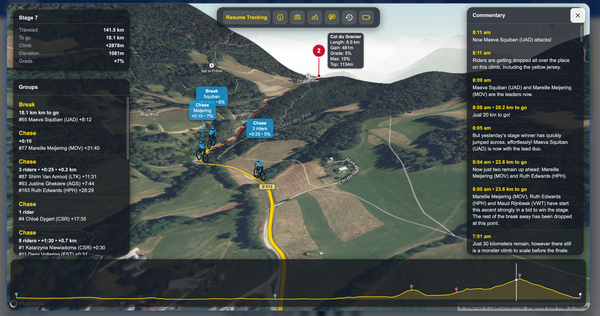
Get our full coverage of the Tour de France and every race we cover with our mobile app! The apps have over 100 additional exclusive features, including our award-winning Time Machine feature that lets you pause/rewind/replay the entire app to sync with delayed race video, integrated Fantasy Cycling, push notifications, an integrated news feed, live GPS tracking, world-class commentary, and our animated interactive maps and profiles.