2017 Tour de France Stage 3 Results & Recap

Stage 3 of the 2017 Tour de France is in the books. The final results and standings are below, followed by our recap of how the race unfolded.
Race Recap
CyclingTips Stage 3 review
Sagan pulls foot from pedal in sprint, still wins Stage 3 of Tour de France
by Neal Rogers
Even with a cleat pulled from the pedal in the final 300 metres, world champion Peter Sagan was able to hold off Michael Matthews and Dan Martin to win Stage 3 of the Tour de France.
The Bora-Hansgrohe rider won the 212km stage that began in Belgium, traveled through Luxembourg, and finished in France, atop the 1.6km Cat. 3 climb, the Côte des Religieuses at Longwy.
It was Sagan’s eighth Tour stage win, and one of his most memorable, as his strength and agility made up for a pedal slip that might’ve ended many riders’ hopes.
After Richie Porte attacked inside the final kilometer, Sagan reeled in the BMC Racing leader and rode at the front. He looked positioned to hold off the bunch, but as he wound up his sprint, his foot slipped from his pedal. Sagan’s mistake gave hope for Matthews (Sunweb) to take the victory, but the world champion was able to return to speed and hold off the Australian.
Asked if he had felt pressure to win on a stage that seemed tailormade for his abilities, Sagan just smiled. “What is pressure? I don’t know what it is.”
Race leader Geraint Thomas (Team Sky) finished eighth, just ahead of defending champion and teammate Chris Froome, meaning there was no change in race leadership, though Froome moved into second overall, 12 seconds behind his teammate.
“First I have to say thanks to all of my team, they did an amazing job all day riding on the front,” Sagan said. “It was not easy, it was very technical at the end, and there was a lot of stress in peloton.
“In the end, it was a pretty hard climb. BMC did a good job for Richie, and then he attacked in the last 800 metres and got a gap. I said, ‘Okay, I will go,’ but I caught him early, at 400 metres to go, and that seemed too far away. At that moment, I thought, ‘Oh no, I went too early again.’ Then I pulled my foot out of the pedal, and I thought, ‘What is happening today?’ Michael Matthews almost beat me, so I am very happy for this victory.”
Six becomes nine becomes one
Sunny skies greeted the peloton for the 212.5km route from Verviers to Longwy, which was contested in three different countries: Belgium, Luxembourg, and France.
After 10km, Nils Politt (Katusha-Alpecin), Adam Hansen (Lotto-Soudal) and Romain Hardy (Fortuneo-Oscaro) opened a 20 second lead over Romain Sicard (Direct Energie), Frederik Backaert (Wanty) and Nate Brown (Cannondale). Before long, it was a six-man breakaway that would spend the day together, off the front.
After 82.5km of racing and one Cat.4 climb, won by Brown, the gap hovered at just under two minutes.
After the Cat. 4 Côte de Wiltz, won by Politt ahead of Backaert, Politt and Brown rode away from the rest of the breakaway. With each rider haven taken max points on the first two Cat. 4 climbs, it looked to be a two-man battle to the top of the next climb, the Cat. 3 Côte d’Eschdorf, which quickly followed the Côte de Wiltz. However Brown attacked and went clear, taking the lead in the KOM competition with two categorized climbs remaining.
With 92km to go, the gap from Brown to the yellow jersey was over 3:40; he held a 50-second lead over Politt, but sat up over the top of the Côte d’Eschdorf and waited. However with Politt also sitting up to wait for the rest of the breakaway, it was a six-man move once again with 90km to go, and the gap up to four minutes.
The gap came down quickly, and with 60km to go, just one minute separated the leaders from the main bunch.
As the catch grew close, three riders jumped from the bunch — Thomas De Gendt (Lotto-Soudal), Lilian Calméjane (Direct Energie) and Pierre-Luc Périchon (Fortuneo-Oscaro).
Shortly after, a crash in the bunch saw several riders down, including Alexis Vuillermoz and Oliver Naesen (Ag2r La Mondiale), and Dario Cataldo (Astana).
With 57km to go, the three bridging riders made contact with the six at the front, making a nine-man group with two from Lotto-Soudal, two from Fortuneo-Oscaro, and two from Direct Energie.
However as De Gendt and Hansen took pulls at the front, Sicard struggled to hold the wheel.
Behind, riders from Bora-Hansgrohe and Quick-Step Floors drove the chase.
With 47km to go, Politt jumped on a slight ride in the road, Calmejane, De Gendt, and Périchon jumped clear, with Hardy bridging across to make four at the front, including two wearing the white jerseys of Fortuneo-Oscaro.
As the pace picked up and riders like Politt, Brown, and Hansen were swept up by the bunch, last year’s second-place finisher Romain Bardet (Ag2r) had a mechanical issue that required a bike change, losing 30 seconds to the bunch. Teammates Cyril Gautier, Axel Domont and Ben Gastauer dropped back to help Bardet return to the peloton.
First Hardy and then De Gendt dropped from the four-man lead group, and with 21km to go, Calmejane rode clear of Périchon as the gap to the yellow jersey came down to 50 seconds.
With 13km to go, a crash saw John Degenkolb (Trek-Segafredo), Vasil Kiryienka (Team Sky), and Borut Bozic (Bahrain-Merida) on the ground.
At 10km Calmejane was caught, and the battle for the stage win was reset.\nThe finale
With 2km to go, German national champion Marcus Burghardt rode at front with Greg Van Avermaet on his wheel, followed Zdenek Stybar (Quick-Step Floors).
BMC’s Alessandro De Marchi came to the front to help, with Porte moving up. Alberto Contador (Trek-Segafredo) sat third wheel, while Sagan was not in great position, four or five wheels back and momentarily boxed win.
Porte attacked with about 900 metres to go, and opened a gap. However Sagan closed the gap, and went to the front. As he opened up his sprint, his right foot disengaged from the cleat. Sagan calmly found the pedal and clipped back in, continuing his sprint to the line.
“It was a pity that Sagan lost his pedal, that put me right out in the wind,” Van Avermaet said. “I might have had a better chance from his slipstream.”
Calmejane was awarded the day’s most combative prize, while Brown took the KOM jersey from teammate Taylor Phinney. Marcel Kittel (Quick-Step Floors) retained the green points jersey, and Pierre Latour (Ag2R La Mondiale) moved into the white jersey of best young rider.
Link: https://cyclingtips.com/2017/07/sagan-pulls-foot-pedal-sprint-still-wins-stage-3-tour-de-france/
___________________________________________________
Last chance saloon? Contador gambles on new Tour de France approach
by Shane Stokes
Well into his 30s and with the Giro a stated aim for next season, this year’s Tour almost certainly represents the final chance for Alberto Contador to return to the top of the podium in Paris. Thanks to a different approach, he believes he is on track.
LIÈGE, Belgium (CT) – Changing habits isn’t easy, but Alberto Contador is counting on a new tactic to bring him success.
It’s ten years after his first victory in Tour de France, and he is seeking to turn back the clock. Now 34 years of age, and two years since his last Grand Tour win, he is squaring up to younger competitors with one goal in mind: returning to his best and winning a third Tour de France.
In order to do that, Contador has gone against his natural instinct this year: namely, that of going for victory in every race that he does.
The Spaniard has certainly had a good season, placing second in the Vuelta a Andalucia, Paris-Nice, the Volta a Catalunya and the Vuelta al Pais Vasco.
However he then backed off, making clear prior to the Critérium du Dauphiné that he wasn’t riding for the general classification in the event. He sat up on some of the climbs and ended up 11th overall, a full five minutes and 20 seconds behind overall winner Jakob Fuglsang.
That was a change from recent years. Consider his past results in the race: in 2007, prior to that first Tour win, he was sixth in the race. Two years later, a month before his second Tour win, he was third. In 2010 he was second; in 2013 he was 10th, in 2014 second and in 2016 fifth.
Every time he has ridden the race he has aimed to be in the results. However this time around he held back on that goal.
“Basically, by this approach to the Tour I think I can arrive with more guarantees to the race,” he said in the Trek-Segafredo pre-race press conference. “Cycling is very difficult and for me always I prefer to win each race and also to be competitive in training. But I understand that thinking of my main objective, it was better to choose this way to approach the Tour. I think in this moment I feel better than last year.”
Contador moved to Trek-Segafredo last winter, and that’s key to his new approach. Luca Guercilena is the team manager there and he was one of the people who convinced him to hold back on his ambition in June. Not only would he have to be willing to not go too deep during the race, he also would need to be less sharp going into it.
The idea was to bring him to the boil more slowly, ensuring he is both at a higher level at the Tour but also having greater reserves than in recent years.
“It is clear,” said Guercilena, “that if you want to try to do your best in a three week Tour, you should change the approach you have a bit as your age is going into the higher numbers. That is why we decided to have a softer approach to the Dauphiné, because we know that a three-week race is quite long.
“In cycling, you really need to arrive in a proper way on the first day and then just progress during the race.”
Even though there’s a logic to what he says, Contador had a long-running pattern of wanting to ride aggressively in races. It’s hard to undo habits, particularly when the stakes are high.
Was it difficult to convince him to change his approach?
“No, not really,” Guercilena answered. “Simply because, as you know, last season I worked with Fabian [Cancellara] in his last season. Obviously even for him the approach to the races was different than before.
“Age is a factor. Big champions are not changing the quality of their performance but, let’s say, the training to arrive at this quality is different. You need to take care about that.”
“I think I’m in similar shape to 2014”
Contador’s need to trust in the process, to believe the new approach will pay off came under an early test on day one of the Tour de France. He said on Friday that he wouldn’t take chances in the technical parts of the course if there was rain, but that he would give it his all in the other sectors.
He was aware he could lose some time, but didn’t expect to be as far back as he was. He ultimately finished 68th, 54 seconds behind the winner Geraint Thomas (Sky). He also yielded 42 seconds to Thomas’ teammate Chris Froome, who was sixth.
He said afterward that the bad crash of his fellow Spaniard Alejandro Valverde played a factor in the time lost.
“I heard that Alejandro had fallen and we decided to go very carefully in the corners,” Contador explained. “My priority was to go in the corners with great care, and in the straight lines I think went quite fast.
“In the parts where I had to pedal I felt good, although 42 seconds is a lot for 14 kilometres. But this has just begun. Obviously, Froome has made some great differences, he is ahead, so there’s no other way but to go on the offensive. But until we get to the first mountain stage and see how the legs are, you cannot say what tactic to adopt.”
As the race progresses it will become more clear if Contador was hampered by form or by caution. It’s certainly possible he played this more safely than others: after all, he retired from two out of the past three Tours either solely or partially due to crashes.
In that light, staying upright was hugely important to him in Düsseldorf.
But how does he think he is going? Prior to the 2014 race, Contador said that he was in his best Tour de France form in years. Asked at this year’s pre-race conference to compare his condition then and now, he was optimistic.
“We will see in the race,” he said. “But at this moment, I think I’m in similar shape to 2014.”
Questioned further, he elaborated on how he knew he was on track.
“Basically it is a question of how many watts I move. It is a question of climbing times, and it is a question of weight. All of these give me these answers. I feel more or less like 2014.
“At the moment I can say that my preparation has been very good. I think I have done the right thing. So we will see.”
Guercilena said that he was similarly optimistic.
“I have to say that I am convinced that he can fight for yellow,” he stated. “It is true that the competitors are younger. Someone last year [Froome] proved that he was stronger [then].
“As usual, I always say to the riders that you need to know your limits if you want to be competitive. And I think that this is the case. That is why we changed our approach to the Tour, because we know that it will be a tough race and the competitors are really strong. We are not coming here saying, okay, we will just take the start and win.”
Still, even if he underlines the dangers of any complacency, he also stresses that he believes Contador is where he should be.
“I think he is in shape. We respect his past data – he is on a good level. Then we will see what is the strategy of the race and how the other teams are riding and working. And we will try to do what we think is good for us to do to get the yellow.”
At his strongest in week three?
Even if the time trial dented his morale, the memories of that slippery, rain-saturated day will soon fade. The stages ahead will give a much clearer picture to Contador. Indeed, given that he was further back on his racing form than his competitors in the Dauphiné, it is possible that he may need a few days to sharpen up.
The uphill finish on Monday’s third stage to Longwy should give him the first indication, even if the climb is less than two kilometres in length. A clearer picture will likely emerge on stage five to La Planche des Belle Filles, which is 5.9 kilometres long and reaches gradients of 20 percent in steepness.
By Wednesday evening, he will have a far better idea of where exactly he is at.
“Stage five is one I am curious about,” he said. “In 2014, on stage 10, I felt very well and was eager to go there [to the same final climb] and try to win. But unfortunately I crashed on the road.”
This time around, he’s got a chance to exorcise those ghosts with a strong performance there. Should he do so, he will know that he is indeed where he needs to be to chase yellow.
After that, tactics will be vital. As both Contador and Guercilena note, this year’s Tour is atypical: there are climbs dotted throughout, for example, with the race visiting five mountain ranges. There are quite a few shorter, steeper climbs, and there are also mountain stages that finish with descents.
Fortunately for the Spaniard, he has shown time and time again that he is strong on improvisation on the road. An attack on the rode to Fuente Dé in the 2012 Vuelta a España saw him wrest the race lead away from Joaquim Rodriguez and paved the way for his final victory in that event.
Last year, another surprise attack forced a large break clear and helped Nairo Quintana (Movistar) establish what would prove to be a crucial buffer on Chris Froome. Quintana went on to win the race as a result.
Because of this racing instinct plus the atypical course, a fit Contador would be doubly dangerous for his rivals.
Guercilena is hoping for one more thing. That is, that Contador’s lighter June will give him more reserves in July. As the race grinds on, as the kilometres tick down and the summits clock up, fatigue will set in. In theory at least, the rider with the most reserves should remain strong as the days tick by.
“Our plan is that his form will progress,” Guercilena says. “Of course, if you aim to progress in the third week but the first two weeks are really, really hard, then it is complicated to arrive well in the third week. But, normally, his form should progress during the three weeks.”
Contador confirms this approach, but is also quick to remind that he has been going well earlier this year.
In contrast to Froome, for example, he has regularly been on the cusp of a stage race win.
“When Luca spoke with me [early on], put his confidence in me for the Tour de France, he was thinking of fighting for the Tour,” he said. “The objective was always to arrive here in optimal condition.
“But, for sure, we have fought also at the beginning of the season. I think in total I lost four races only by 20 seconds. That means a lot. Still, it is true that we have been focussed on the Tour, for sure. Everybody knows how important this race is, and is for us.”
Ten years ago Contador won his first Tour. A decade later, he’s still fighting for yellow. There have been many peaks and troughs along the way, with highs such as his victories in races like the Giro d’Italia and Vuelta a España, and lows such as crashes, injury and his positive for Clenbuterol.
But, at 34 years of age, he believes – he hopes – that he’s still got what it takes.
He’s certainly still got the same burning ambition he showed as a younger rider.
“I am very eager to still be here after ten years,” he said. “It means [a lot] that, after many generations of rivals, I can still be a favourite for the Tour.
“I didn’t change too much during this time. I have more experience, for sure, that can help me.
“But about motivation, about being eager to fight for the race … nothing has changed.”
Link: https://cyclingtips.com/2017/07/last-chance-saloon-contador-gambles-new-tour-de-france-approach/\n
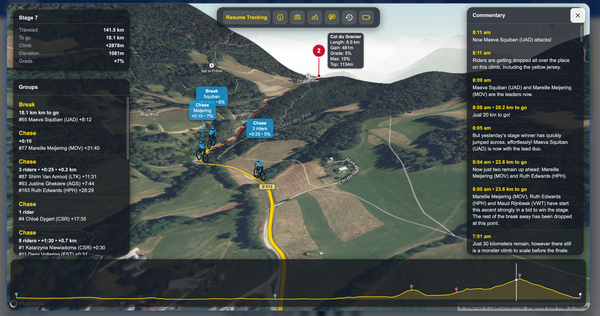
Get our full coverage of the Tour de France and every race we cover with our mobile app! The apps have over 100 additional exclusive features, including our award-winning Time Machine feature that lets you pause/rewind/replay the entire app to sync with delayed race video, integrated Fantasy Cycling, push notifications, an integrated news feed, live GPS tracking, world-class commentary, and our animated interactive maps and profiles.