2017 Tour de France Stage 15 Results & Recap

Stage 15 of the 2017 Tour de France is in the books. The final results and standings are below, followed by our recap of how the race unfolded.
Race Recap
CyclingTips articles
Mollema solos from breakaway to Stage 15 victory at Tour de France
by Evan Hartig
Bauke Mollema (Trek-Segafredo) crossed the line alone on Stage 15 of the Tour de France on Sunday. The win in Le Puy-en-Velay marked his first ever Tour de France stage win. Chasing 19 seconds back was Diego Ulissi (UAE Team Emirates) and Tony Gallopin (Lotto-Soudal).
The final selection came from a 28-rider breakaway that rolled on the first climb of the day, the Montée de Naves d’Aubrac. Tony Martin (Katusha-Alpecin) went away with a solo attempt 60 kilometers out, but was overcome on the final category 1 ascent by the proficient climbers in the move behind.
GC leader Chris Froome’s Team Sky had no intentions of bringing the large selection back, as the highest-placed rider within the move, Damiano Caruso (BMC) was over 11 minutes down.
“It’s amazing, I’m so happy to finally win a stage at the Tour de France, I just can’t believe it,” Mollema said. “It’s what I have worked for so hard over the last few years. I knew there was a chance at the beginning of the stage, there was a strong breakaway, about 10 guys, but there were a lot of teams that wanted to block the road, so we couldn’t pass. Finally my teammates got to front, [Michael] Gogl, and Koen de Kort, and we kept the speed up in the peloton. On the first climb we went full gas, trying to bridge to the leaders. Finally we made it, with 25 guys, we made the breakaway. I felt good and gave it a try in the last 30km. I think I’ve never done such a long ride alone. But in the end, I made it.”
Regardless, there would be a race within the main field. Approaching the Montée de Naves d’Aubrac, Ag2r La Mondiale took the front and set an intense pace into the lower slopes of the climb.
Froome quickly found himself distanced, but made it back with the help of his team. Moments later, he had a rear flat, and was again distanced, this time substantially. Again, Froome had teammates with him who aided in his ultimate return to the field. Doubtless, the two situations caused back to back panic within the Sky camp.
“It was a pretty scary moment,” Froome said. “There’s never a dull moment at this Tour. Coming into the foot of the main climb, Ag2r took the race on, and at that moment I had to change my back wheel. I stopped with [Michal Kwiatkowski], changed the wheel, and the rest of my teammates sat up and paced me back. On the last little bit over the top, Mikel Landa dropped out of the front group to help me for the last few hundred metres, but it was pretty scary. I thought the jersey could change hands again. I’m grateful to be in yellow, and again I want to say ‘thank you’ to my teammates for amazing work today.”
Link: https://cyclingtips.com/2017/07/mollema-solos-breakaway-stage-15-victory-tour-de-france/
-----------------------------------\nCommentary: UCI’s lack of consistency in application of rules is unacceptable
by Daniel Ostanek
We’re out of the Pyrenees, and the Tour de France is two-thirds over. As far as racing goes, it’s been what can charitably be described as a slow burner, but there have been several standout images that define these first two weeks.
Maybe the memories of Marcel Kittel easing to victory over and over in the sprints is the first to spring to mind. Or perhaps it’s Richie Porte’s sickening crash on the descent of the Mont du Chat? Or Warren Barguil’s win in Foix, a Frenchman on Bastille Day for the first time since David Moncoutié in 2005.
However for others — for many, perhaps — the defining memory thus far has been of the UCI commissaires, the multiple contentious decisions the group has undertaken, and the path the men have taken to make those decisions.
First of all, there was the Peter Sagan disqualification. Well, first there was the relegation and 80 points penalty, later revised upwards after much confusion and debate about the crash on stage 4 which ended Mark Cavendish’s race.
Six days later came Nacer Bouhanni’s measly 200CHF fine and one minute GC penalty, after the Frenchman was caught on camera taking a swipe at Quick-Step Floors rider Jack Bauer in the final kilometres of Stage 10. Sandwiched between the two, on stage 7, was the Kittel and Edvald Boasson Hagen photo-finish sprint. Kittel was declared the winner, but no conclusive evidence of his victory has been released to the public.
Of course, the most recent flashpoint came in the Pyrenees on the road to Peyragudes. GC contenders George Bennett and Rigoberto Urán were docked 20 seconds for taking illegal feeds on the final climb; feeding is prohibited in the final 10km on a mountain stage, and in the final 20km on most stages.
Question after question arose from the penalty. Why them and not Romain Bardet, who also appeared to take a drink from the same spectators as Bennett? Did it matter that the bottles weren’t from team members? Did the rule prohibit the act of taking a bottle, or the act of drinking from it?
Eventually those penalties were taken back, with the commissaires excusing the duo on the grounds that race caravan traffic had made feeding difficult in the moments before the 10km-t0-go cutoff.
Bennett, currently fighting for a top 10 GC spot, was happy about the final outcome, but shared the puzzlement of many about the process, even the rule itself.
“I didn’t even know [about the rule] until yesterday — I’m dead serious,” he said the next morning to CyclingTips and ITV reporter Daniel Friebe. “I’ve never heard that rule. I also saw somewhere that the rule is that you can take it from a spectator as long as it’s not team personnel, so I don’t actually know what the rule is.
“I was definitely taking bottles off people, chucking them over my head. I didn’t know it was in the rules, but I do now. You live and learn,” he added. “I guess I’ll probably seek some clarification on if you can take it from spectators or not. I still don’t really know.”
And this is the problem. Journalists and fans can spend their time poring over the vagaries of the UCI rulebook in order to figure out what’s going on (though in this case, not so much), but if the guys out there racing don’t know them then what use are they? Regulations that are so vague that they can be interpreted in so many different ways are pointless.
Sagan’s initial penalty was based on the rule prohibiting ‘deviating from selected lane, endangering other riders’, which sounds fair enough. But later in the day his offence was upgraded to ‘irregular sprinting’, which can see a rider eliminated from the race in ‘particular serious cases’. What changed? Did any new evidence come to light? If so, what was it?
Bouhanni’s pugilistic act appeared far more intentional than Sagan’s line and his balancing elbow. Yet the Cofidis rider has been allowed to race on. You only have to cast your mind back to February to remember Andrey Grivko being thrown off the Dubai Tour for punching Marcel Kittel off-camera. The Ukrainian was later banned from racing for 45 days for ‘behaving in a violent manner’ (rule 12.1.005). What was the difference? That he drew blood?
Many point to the weak action against French riders (Bouhanni, Démare cutting up his fellow sprinters, Bardet getting off scot-free for bottlegate) as evidence of the race favouring their home stars. But this is a misconception — the UCI commissaire jury for the Tour is independent of the ASO, and made up of a Belgian, a Frenchman, an Italian, and a Spaniard.
“A cynic would say that,” Bennett said, when it was put to him that the commissaires strived to avoid penalising Bardet. “I guess you could look at it from the outside and say that. Yesterday when it was me and Urán, and then you saw the footage of Barguil and Bardet and they did a 180.”
“But I think maybe that’s just a coincidence, potentially. I don’t know, because the guy from the jury, Philippe isn’t French is he? [He’s Belgian] They weren’t docking Tiesj Benoot or Jan Bakelants.”
So maybe not overtly biased, one would hope, but that’s not to say that some might be reticent at the thought of throwing major French riders out of the Tour de France. This notion of a crowd-pleasing jury is, however, undercut by the fact that they disqualified the biggest star in the sport — the man wearing the rainbow jersey, the UCI’s most prized and recognizable property — on Stage 4.
Meanwhile Stage 12 showed us that the misguided actions of the commissaires are not merely limited to the hectic moments of bunch sprinting.
Yes, taking a feed when Urán, Bennett and Bardet did is illegal, but it comes with the caveat that the commissaires can change the prohibitions on feeding so long as the decision is communicated before the stage. Of course, such problems as those with the traffic are not foreseeable, but still – the rules around feeding seem so malleable in interpretation as to render them meaningless.
It’s a matter of communication, too. Aside from giving out the sanctions and citing the rule, there is no communication or reasoning for the actions taken. The UCI refused to comment on the reasoning behind Bardet’s lack of punishment, other than to say they hadn’t seen evidence, which was abundant.
How much can the UCI be trusted when decisive evidence showing who won a Tour stage has been kept secret? Or when one rider is disqualified over an offence that is debatably unintentional while another is not over a clearly overt offence? Or when there is no explanation given when some riders are sanctioned for feeding, while others doing the same were not?
The shambolic situations and their fallout might be the most high-profile of the year, but they are by no means the first. Back at Omloop Het Nieuwsblad there was no punishment as the lead group raced on the off-limits bike paths — a situation only remedied when race organisers took it upon themselves to erect barriers on the paths.
A month later, Movistar’s penalties for pushing one another during the Volta a Catalunya time trial were also the result of a confused, convoluted process. Initially a handful of their riders were given time penalties for pushing one another before, 16 hours later, the entire team was handed the same penalty, taking Alejandro Valverde out of the race lead.
There are several takeaways from this litany of incidents. First of all, the UCI rulebook needs to be scrutinized. Clearly there is far too much wiggle room and ambiguity in the wording of regulations — from rider to rider, action to action, race to race. When even the commissaires seem to so often be confused over what to do, it’s clear that changes are needed.
Certain regulations will always be debated, with decision coming at the digression of the commissaires (how sticky was that bottle? how irregular was the sprint?), but wavering over decisions to such an extent as we have seen, as well as the lack of consistency in application, is unacceptable.
Then there’s the far less provable talk of decisions being made to favour certain riders or nationalities. The number of fans and commentators throwing around such theories has meant that, however unlikely, the possibility has been a talking point. And yet there is no pushback from the UCI, no explanation for why Bardet was not penalised. Just an unsatisfying rollback of all the penalties, and refusal to comment.
Communication has always been an issue for the UCI, even in Cookson’s supposedly transparent iteration of the governing body. The decision-making process either is confused, or the people involved are making it look that way.
Any penalties handed down should be made clear, along with the corresponding rule and the thought process involved — and not just for the benefit of the press and fans. Even Cannondale-Drapac boss Jonathan Vaughters was left in the dark during the decision-making process on Thursday.
Too often, the application of UCI regulations is a farcical affair. It’s easy to say that things usually turn out alright in the end, but that’s not really the case. At a Tour de France where the top four riders are separated by just 29 seconds, it’s fair to say that a 20-second penalty has real consequences. As of Stage 14, Bardet and Uran are separated by only six seconds, so yes, 20 seconds make a real difference.
Changes in the process, the final application, and the regulations themselves, are all needed. The high standards expected by the UCI of riders and teams should also be expected of those governing the sport.
At almost every Grand Tour a debate is held about the ‘unwritten rules’ of the sport, and this Tour was no exception. But now, just as often, the debates concern the written rules which are free to view for anybody, but which are also seemingly open to interpretation.
Professional cycling is full of nuance. Anyone closely involved — riders, fans, journalists — has to, at times, explain those nuances to those less familiar. At a time when competition for viewership and attention spans has never been greater, the UCI is doing the sport no favors by creating an atmosphere where there is no explaining the inexplicable. Cycling has suffered through plenty of credibility issues in the past, but the latest batch — caused by officials of the sport’s governing body — cannot be tolerated.
Link: https://cyclingtips.com/2017/07/commentary-ucis-lack-consistency-application-rules-unacceptable/
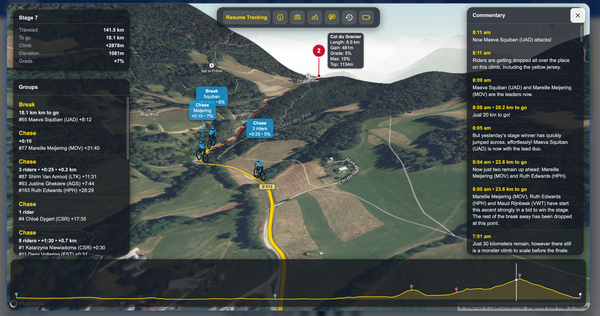
Get our full coverage of the Tour de France and every race we cover with our mobile app! The apps have over 100 additional exclusive features, including our award-winning Time Machine feature that lets you pause/rewind/replay the entire app to sync with delayed race video, integrated Fantasy Cycling, push notifications, an integrated news feed, live GPS tracking, world-class commentary, and our animated interactive maps and profiles.