2017 Tour de France Stage 14 Results & Recap

Stage 14 of the 2017 Tour de France is in the books. The final results and standings are below, followed by our recap of how the race unfolded.
Race Recap
CyclingTips Race Recap
Matthews takes Tour de France Stage 14 uphill sprint, Froome moves back into yellow
by Evan Hartig
Australia’s Michael Matthews (Sunweb) sprinted to victory on Stage 14 of the Tour de France Saturday, edging out Greg Van Avermaet (BMC Racing) and Edvald Boasson Hagen (Dimension Data) on the final 500-metre uphill sprint. It was the first Tour win of for Matthews at this Tour, and the second in his career. It was also the second Sunweb victory in 24 hours, following Warren Barguil’s win at Foix on Friday.
Matthews thanked his Sunweb team for their disciplined work during the stage.
“I think it was as expected,” Matthews said. “[Sunweb] rode all day. The breakaway was so close, I knew it would be hard to have teammates in the final, we rode hard to bring them back. But I was still able to have two or three guys with me there in the final. It was a perfect day.”
Race leader Fabio Aru (Astana) was distanced on the punchy finale, surrendering the yellow jersey back to Chris Froome (Team Sky). Froome assumes the maillot jaune once again, this time by 19 seconds over Aru. Romain Bardet (Ag2r La Mondiale) still sits third, 23 seconds down, with Rigoberto Uran another six seconds back in fourth.
After two strenuous days in the Pyrenees, the peloton came down out of the mountains for Stage 13. It wouldn’t be a flat day, however, with two Category 3 climbs on the profile, in addition to a steep final 500 meters.
Thomas Voeckler (Direct Energie), Timo Roosen (LottoNL-Jumbo), Thomas De Gendt (Lotto-Soudal) and Maxime Bouet (Fortuneo-Oscaro) formed the breakaway from kilometer 1. Five kilometers later, Reto Hollenstein (Katusha) jumped from the field to make his way up to the leading four.
The intermediate sprint came at 55 kilometers in Rabastens. De Gendt crossed first from the breakaway, taking 20 points. Behind, Marcel Kittel (Quick-Step Floors) continued to vigilantly defend his lead in the green jersey competition, crossing the line first from the peloton and taking ten points for his effort. Matthews finished second from the field, receiving seven points. Within the competition, Kittel leads Matthews by over 100 points.
The finish to Rodez was won by Van Avermaet in 2015. Saturday, the Belgian again had intentions, as his BMC teammates were vigilant on the front of the peloton, moderating the gap to the leading five.
“Without Richie [Porte], our main objective now is stage wins,” Van Avermaet had said at the start. “Today is my big chance. I have the support of the whole team to keep the peloton together. Hopefully I can write the same script as two years ago. But the competition is high with Matthews, Degenkolb, Gilbert, Boasson Hagen and maybe a few GC guys in the mix as well. But I’m ready for it. I feel a lot pressure. I’d prefer to be here helping Richie instead. It’s been a hard Tour for me so far because I couldn’t show my real good legs. The only big chance I had before today was [stage 3 in] Longwy. It hasn’t been a Tour for attackers so far so I prefer to play my cards from a sprint finish today as well.”
Aiding the men of BMC was Sunweb, working for Matthews, and Bahrain-Merida, for Sonny Colbrelli. The teams in front lacked generosity towards the breakaway, not letting their margin rise above three minutes.
De Gendt took both intermediate KOM’s atop the Côte du viaduc du Viaur and the Côte de Contrès.
At 38 kilometers remaining, on the ascent of the Côte de Contrès, De Gendt’s pace distanced Bouet, Hollenstein, and Roosen. Voeckler was the only one with the ability to follow De Gendt’s pace, and over the top of the second categorized ascent the two found themselves alone. Six kilometers later, De Gendt went solo.
Today’s breakaway attempt solidifies De Gendt as the rider with the most time off the front of the 2017 Tour de France. The Belgian has amassed almost 600 kilometers off the front of this year’s race.
“I’m happy now even if I was a little frustrated during the stage, but I was just not good enough,” Voeckler said. “I did my share of the turns, we rode a great ride. You must show fair play, too, I was not the strongest in the breakaway and the peloton played it right. I believed we could make it. Attempts like this, after two weeks in the Tour, you never know. Some riders can be tired and Thomas De Gendt is a rider who is better in the second part of the Tour. So yes, I believed we could make it.”
The gap continued to fall due to the diligent work of Sunweb and BMC on the front of the peloton. With 12km remaining, Swiss powerhouse Michael Schär took the front. De Gendt’s gap diminished until it was negligible, and the Belgian was reeled in as Tony Martin (Katusha-Alpecin) took the front of the field.
Counterattacks immediately flew. The first instigator was Maurits Lammertink of Katusha-Alpecin, and he was immediately followed by Damiano Caruso (BMC), Nikias Arndt (Sunweb) and Pierre-Luc Périchon (Fortuneo- Oscaro). Lammertink was motivated to create distance, but Périchon was the only one with any intentions of helping. Caruso and Arndt were dead weight, covering the move for their respective team leaders and not pulling through.
The four, with only Lammertink and Périchon pulling, were able to gain 13 seconds going into the final, but their gap quickly diminished.
Quick-Step Floors was on the front of the field behind, setting tempo into the base of the final climb for Belgian puncheur Philippe Gilbert. With five kilometers to go, Caruso, Arndt and Périchon had surrendered, but Lammertink wasn’t content to go down easily. He remained out front for another kilometer before finally succumbing to the vicious pace being set behind.
Belgian champion Oliver Naesen (Ag2r La Mondiale) led into the base of the final ascent. On his wheel was Gilbert, followed by Van Avermaet, John Degenkolb (Trek-Segafredo) and Matthews.
“The finish went how I wanted it to go because there was a lot of wind,” Van Avermaet said. “I was hoping that I didn’t have to go too early and I think the two Belgian guys, Oliver Naesen and Philippe Gilbert did a good job and I was in a perfect position. Then, I tried to launch my sprint to victory but Matthews was amazingly strong and he deserved the victory today.”
Matthews launched his final kick with 100 meters remaining, easily coming around Gilbert and Van Avermaet for the win.
“The last time on this finish, two years ago, I had four broken ribs, and skin all off my body,” Matthews said. “This was the stage I was targeting before my crash, so now to come back to the same finish, to win it like that, it’s a dream come true.”
Aru was distanced on the final climb, and he succumbed the GC lead back to Froome by 19 seconds. Froome finished an impressive seventh on the stage, just ahead of Dan Martin (Quick-Step Floors) and Uran.
“It helped knowing the finish from two years ago, but that was all about the team today,” Froome said. “They did a great job keeping me at the front, especially in all the twisting corners at the final. Without the team there is no way I could have found myself in that position, especially great work from Kwiato in the final kilometre. In the last 500 metres I was hearing shouting over my radio, they were saying ‘Go, go, it’s blowing to bits.’ It was amazing to hear that.
“It’s still so close between the main rivals, every second counts and is worth fighting for. If we look at how the race blew up yesterday when Astana tried to control, it, hopefully we can bring the peloton into a calmer situation. That said, it’s been a big week for everyone, and I expect it’s going to be war again tomorrow.”
Link: https://cyclingtips.com/2017/07/matthews-takes-tour-de-france-stage-14-uphill-sprint-froome-moves-back-yellow/
------------------------
Commentary: The case for a red ‘combativity’ jersey at the Tour de France
by Gustavo Cinci
The Tour de France, much like the World Cup, is an old sport from the Old World that has captured the hearts of millions, generation after generation. And as an old sport, its structure and arcane ways have been challenged in recent years as attention spans shrink and viewing options expand.
Team managers struggle with sponsorship and often wonder how to monetize the sport. Others attempt to create their own league with signature racing, such as the new Hammer Series assembled by Velon, an organization owned and managed by a collection of teams.
Today’s WorldTour teams shoot short videos that share candid moments in the bus, the pre-race rituals, or take us on rides with them. Technology has done a great job bringing the action and its players close to us. Fans love it. But technology alone can only do so much to gather and retain interest.
Take the second week of this year’s Tour, for example. Looking at the race profiles, I more or less knew what the score was going to be — suicide breakaway heads up the road with a smattering of plucky racers, opens a semi-decent gap, only to be kept leashed by the sprinters’ teams. As such, the break is reeled back in the final kilometers, and if one of the intrepid riders feels particularly frisky, he’ll try another dig to give the viewers the evanescent hope that he might make it to the finish line alone.
Then, as if conducted by a maestro in a hurry, the score gets bumped from presto to prestissimo: The sprint trains wind up and one of the three main sprinters left in the race takes the flowers home.
“Oh, but it’s bike racing,” you say. And I say, “Yes, it is, but we can do better”.
So let’s start with the racing itself, specifically the Tour and its jersey assignments.
Yellow, green, polka-dot and white, in that order, are the flagship jerseys of the Tour. They represent the pinnacle of the sport, and wearing any of those even for a day can be a hallmark moment in a rider’s career.
Donning a prized jersey on the Champs Elysees elicits accolades, perhaps a bonus in pay, and some riders may see their name embroidered on their shoes or saddle — after all, they’ve worked hard to get to this level.
But how about the soldiers who win the breakaway lottery? What of those riders allowed or lucky enough to make the break, those whose sweat cakes on their jerseys into a veritable geographic atlas of pain? What do they get? The sprinters hog the headlines, and the marathon roadie who spent 200km by himself gets a pat in the back, an acrylic trophy, and a red dossard which is worn for a day, until the next day’s “most aggressive” rider is awarded.
Over the last decade, a certain team with a mighty ensemble of stars — riders who, in any other outfit, would be captains or protected leaders — has put its proverbial cleat on the throat of the peloton. The first few times Team Sky displayed its chokehold it was indeed a sight to see. I was impressed with bold displays of strength, cohesion, and craft. After a few years of this formula, I’ve grown tired. Not bored, mind you, but you can only see the same movie over and over before you turn to something else. And herein lies the problem. I don’t want to turn to something else. I need my sporting escapism.
I very much dislike the fait accompli feeling that sets in, the impervious yellow armor that will not be dented, scratched or wrestled away. It’s fair to concede a general malaise when Chris Froome suits up in the yellow jersey. As an athlete and person he is not at fault; he excels in his role and works hard for it. As a personality, he’s not the most dynamic. As a fan, I search for an affinity that is not there.
So let’s add some spice to the Tour, since Froome and his merry band are sticking around for at least another few seasons.
Enter a new jersey competition. Let’s reward the unsung heroes, the breakaway artists, the brave, the lucky, the stupid. The red dossard already exists; Tour organizers ASO should dump it and turn it into a running classification.
How do you bestow a most-aggressive classification? We can start with a calculation of time spent in a breakaway, how far from the finish line the breakaway was caught, how many turns at the front, what kind of stage it was ridden, feats of bravado, plain aggression, cunningness, and a few other variables. It would reward the daring.
Luck favors the brave, or as Romain Bardet has emblazoned on his bike, “Take the risk or lose the chance.”
A most-aggressive classification would spark ingenuity, a quality many critics claim lacks at some high-level races. It would also rewire the brains of young riders, turning them into fearless attacking beasts. The red jersey would become iconic in its raw significance, touching the nerve of even the most casual viewer.
Imagine the competition going from “Hey dude, they want you at the stage to get your red number and Happy Meal toy” to “Looks like you’ll have to ask for a raise after spending a week in red.”
This way spectators would remain interested, lesser known riders would have an opportunity at stardom, and the attention would switch a little bit during transition stages. The race would have more opportunities, more ad revenue, more recognition, and more prominent figures. We can call it the “Prix Thierry Marie de Combativité” (for those under 40, google this guy).
Much of what makes the Tour the Tour cannot be changed. Fans and journalists may lodge complaints, but they cannot change the format to fewer than three weeks, or cap the stages at 160km, or keep Team Sky from buying up all the best talent.
But the current arrangement has become formulaic: Strangle the field, let the sprinters sort themselves out, and if they’re lucky, rookies and climbers might get a chance to shine. As it is, with its distance, difficulty, nervousness, and resulting accidents, a significant part of success at the Tour relies on luck — as Alberto Contador can attest.
A red jersey, by design, would fire up the competition on a daily basis. So imagine a Tour team with its assigned leaders, sprinters, climbers, and attackers. The baroudeurs of the peloton — the Chavanels, the Offredos, the Bodnars, the De Gendts — deserve the same level of respect and recognition. After all, they too spend their lives toiling under sun and sentry to be here. Let’s make them resplendent in red.
Link: https://cyclingtips.com/2017/07/commentary-case-red-combativity-jersey-tour-de-france/
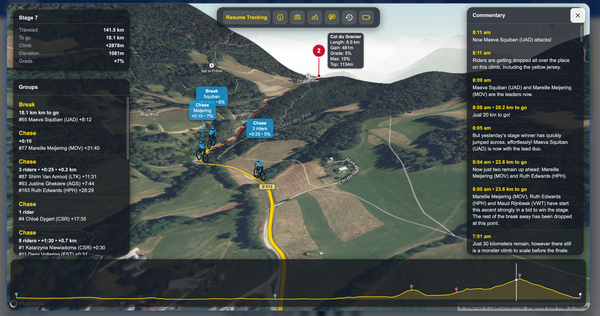
Get our full coverage of the Tour de France and every race we cover with our mobile app! The apps have over 100 additional exclusive features, including our award-winning Time Machine feature that lets you pause/rewind/replay the entire app to sync with delayed race video, integrated Fantasy Cycling, push notifications, an integrated news feed, live GPS tracking, world-class commentary, and our animated interactive maps and profiles.