
Two in the Morning
The knock came for Jonas Vingegaard at around two o’clock on Sunday morning.

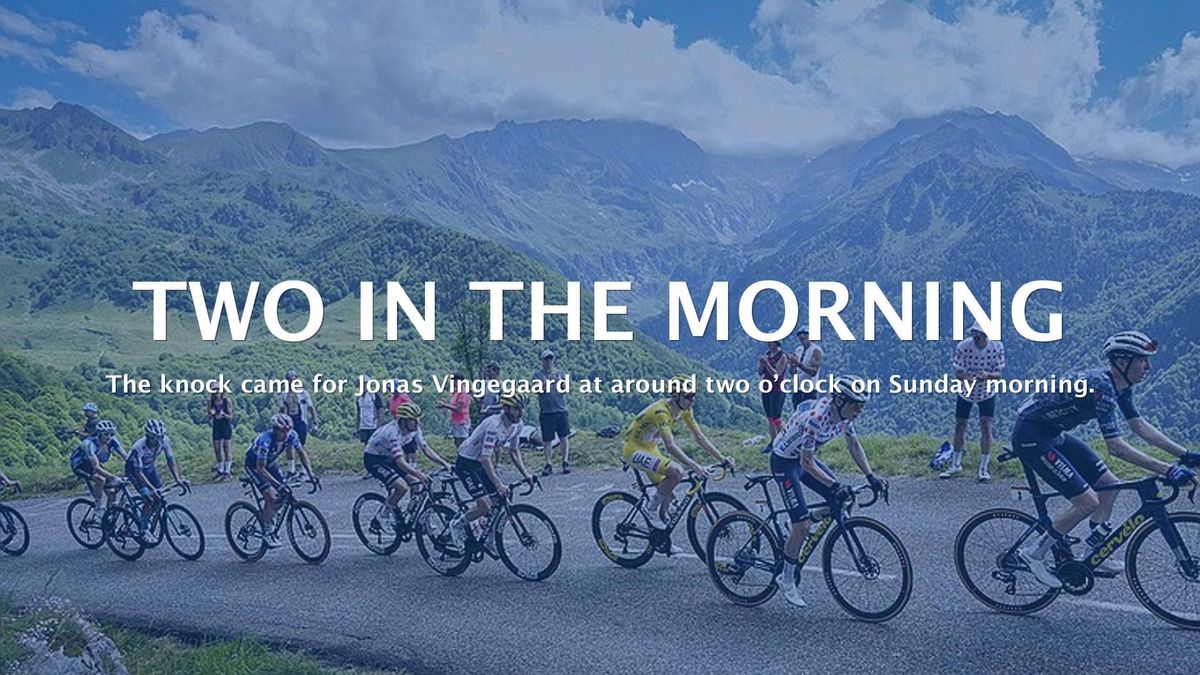
The knock came for Jonas Vingegaard at around two o’clock on Sunday morning. Tadej Pogačar’s came about three hours later. Both men were in bed in the Alps, hours from the start of stage 15 to Plateau de Solaison — the stage that would end Vingegaard’s Tour with a broken collarbone. By breakfast the peloton was angry, and by Monday the story had turned into something considerably stranger than a scheduling complaint.
What emerged, first through L’Équipe and then confirmed by the Paris prosecutor’s office, is that these were not ordinary controls. The International Testing Agency had gone to a judge. Specifically, to a juge des libertés et de la détention at the Paris judicial court, the magistrate who in a criminal context signs off on search warrants, and asked for authorisation to test two riders during the protected overnight hours. Under Article L.232-14-4 of the French sports code, introduced in 2015, that authorisation requires the judge to be satisfied that there exist “serious and consistent suspicions” of an anti-doping violation. A source inside the anti-doping world told L’Équipe this may be the first time the provision has ever been used.
That phrase is now doing an enormous amount of work in a great many headlines, and it is worth being precise about what it does and does not mean. It is a statutory threshold, not a verdict. It describes what a judge concluded about a body of information presented to him in an application he heard from one side only — the ITA has not disclosed what that information was, and neither rider has been charged with, sanctioned for, or accused of anything. Pogačar is tested after every stage he leads; Vingegaard has been among the most tested athletes in the sport for half a decade. Neither has ever failed a control. A reader could take “serious and consistent suspicions” to mean that somebody knows something. It could equally mean that the intelligence-led model of anti-doping is functioning exactly as designed: acting on patterns, not proof, precisely because proof is what it is trying to obtain.
The riders’ objection is easier to state and harder to dismiss than it first appears. Pogačar called being woken in the night inhuman. Remco Evenepoel used almost the same word. Matteo Jorgenson framed it as a failure of respect. Richard Plugge, whose team had the most to lose that day, conceded that the testing was necessary and only faulted the timing. Their argument is not that testing should stop. It is that sleep is a component of both performance and safety, and that a sport which has spent a decade lecturing riders about recovery cannot then treat recovery as expendable on the night before a summit finish.
Set against that is an unglamorous technical reality: the overnight window exists because of micro-dosing. Certain substances clear the body within hours. A control at seven in the morning finds nothing that a control at two would have found. If the window is closed for reasons of comfort, it is closed for everyone, including whoever it was aimed at. This is the trade the sport made after the years it does not like to discuss, and it is not obvious that anyone has a better one.
The uncomfortable residue is the opacity. The ITA will not say what prompted the application, which is defensible — investigations do not survive being narrated — but it means two riders now carry a judicially endorsed suspicion they cannot answer, because they have not been told what it is. Reporting since has muddied the picture further: riders on at least two other teams appear to have been tested at five in the morning during this Tour, which complicates the notion that the yellow jersey and his chief rival were uniquely singled out.
Vingegaard has said it is possible the disrupted night contributed to what happened on the descent. It is possible. It is also unknowable, and the peloton crashes on descents at the end of two weeks of racing for reasons that require no assistance.
What is left is the oldest arrangement in this sport. A rider who wins by four and a half minutes is asked to prove a negative, repeatedly, at hours of the tester’s choosing. That is the price of being believed, and there is no version of professional cycling in which it is cheap.