Tour de France: By The Book
The crazy finances behind the world's greatest cycling race
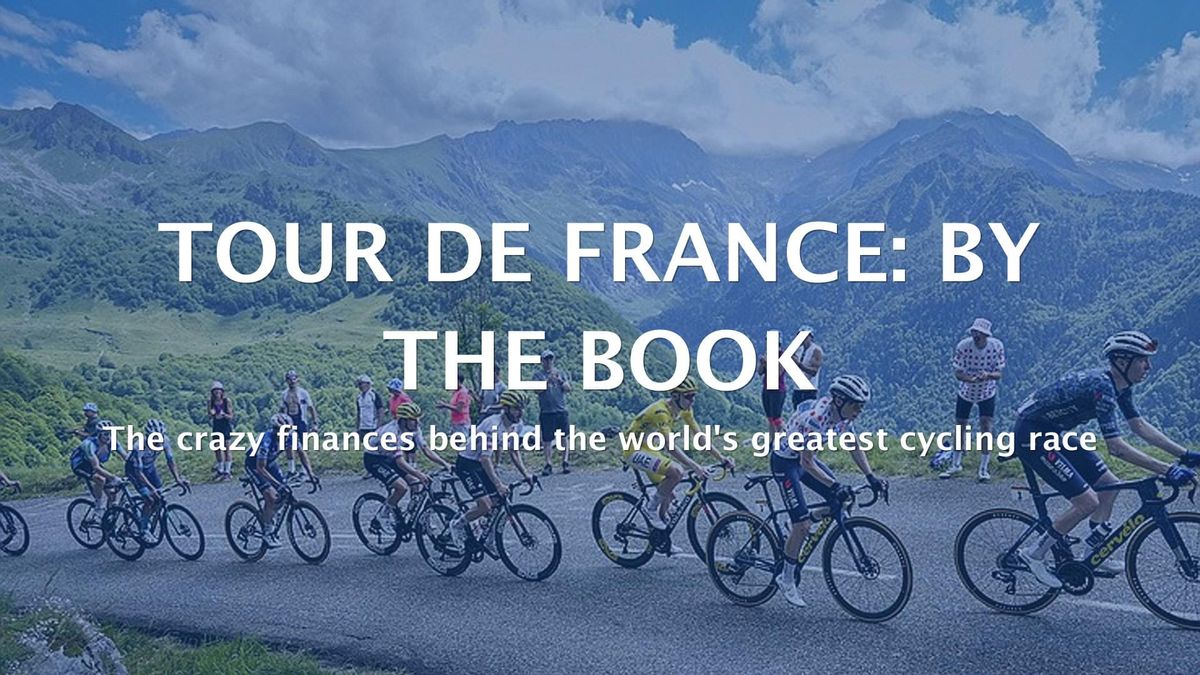
The Tour de France is the rarest kind of blockbuster: a three-week spectacle watched by more than a billion people that never sells a single ticket. Twelve million spectators line the roads for free. So where does the money come from, where does it go, and who actually gets rich? Here’s the Tour, by the book.
The house always wins
The race belongs to Amaury Sport Organisation (ASO), the privately held arm of the Amaury family’s media empire — the same lineage that founded the Tour in 1903 to sell newspapers. It is stunningly profitable. ASO as a whole posted roughly €375 million in revenue and €131 million in net profit in 2024, and the Tour is its crown jewel, generally reckoned to account for around half of the company’s business.
Pinning the Tour’s own numbers down is harder, because ASO guards its books like a maillot jaune with a ten-second lead. Independent estimates put annual revenue somewhere between €60 million and €150 million, with a profit margin north of 20 percent — call it €20 million to €40 million a year from the race alone, and quite possibly more in a strong year. Whatever the exact figure, the Tour is the most lucrative event in cycling by a wide margin, even if it’s a rounding error next to the Champions League or the Premier League.
Where the money comes in
Television is king. Broadcast and media rights are the single largest slice of the pie, usually estimated at 50–60 percent of Tour revenue. France Télévisions serves as host broadcaster, producing the world feed and paying a reported €25 million or so a year, then selling that feed on to partners like NBC in the US and Warner Bros. Discovery across Europe. All told, ASO’s broadcasting rights across its portfolio are thought to run into the tens of millions annually. The 2025 race reached a cumulative audience north of a billion viewers across nearly 190 countries — the product that makes everything else valuable.
Sponsorship is the second pillar, roughly 35–40 percent of income. The four jerseys are individually sold: banking group LCL reportedly pays around €12 million to put its name on the yellow jersey, with Škoda, Continental, Krys and E.Leclerc filling out the top tier. Then there’s the publicity caravan — the parade of branded floats that precedes the race — where some three dozen companies each pay somewhere between roughly €230,000 and €550,000 for the privilege.
Host-city fees are the smallest of the big three but still meaningful. A city bidding to host a Grand Départ abroad pays dearly: Copenhagen (2022), Bilbao (2023) and Florence (2024) each reportedly handed ASO around €6 million just for the fee — before the security, road resurfacing and staging costs that can double the bill. French cities pay less: Lille paid roughly €4.2 million for the 2025 start, and a routine stage start or finish can be had for somewhere north of €100,000. For 2027, the UK is putting up £32.5 million in public money for a Grand Départ. Cities pay because the exposure is worth it — Düsseldorf calculated its 2017 start generated over €340 million in advertising-equivalent value against a €4.5 million fee.
Where the money goes out
ASO’s costs are real but modest against that income: staging and logistics, a core workforce of under 300 people, the enormous production apparatus (the TV operation alone runs hundreds of camera personnel, dozens of vehicles and several aircraft), and the prize purse. Notably, ASO pays the competing teams nothing from its media windfall — a long-running grievance, since teams depend on sponsorship for roughly 85–90 percent of their budgets and see none of the TV riches their racing generates.
The winner’s cheque, line by line
For all its prestige, the Tour’s prize fund is comparatively small — about €2.3 million for the whole race (€2,301,200 in 2025; €2,302,800 in 2026). The overall winner takes home €500,000, a figure that hasn’t moved since 2016 and has crept up only €100,000 since 2005. Here’s how the rest breaks down:
- General classification: €500,000 (1st), €200,000 (2nd), €100,000 (3rd), sliding down to about €1,100 by 19th. Everyone from 20th to 160th — the last-placed lanterne rouge included — pockets €1,000 for reaching Paris.
- Yellow jersey bonus: €500 for every day spent in yellow.
- Stage wins: €11,000 to the winner, with the day’s top 20 sharing €28,650 — over €600,000 across the 21 stages.
- Green (points): €25,000 overall, €300 per day worn, plus intermediate sprints paying €1,500 / €1,000 / €500 to the first three.
- Polka-dot (mountains): €25,000 overall, €300 per day, plus climb primes from €200 up to €800 for the biggest summits.
- White (best young rider): €20,000 overall, €300 per day, €500 to the best-placed under-25 each stage.
- Team classification: €2,800 per stage to the fastest trio, €50,000 to the overall winners.
- Combativity: €2,000 to the most aggressive rider each stage; €20,000 to the overall “Super Combatif.”
- Special primes: €5,000 each for the Souvenir Henri Desgrange (highest Alpine summit) and Souvenir Jacques Goddet (Pyrenean landmark), plus weekly best-teammate awards of €2,000.
And here’s the twist that surprises newcomers: the winner rarely keeps it. By long tradition, prize money is pooled and split among the whole team — domestiques, mechanics and soigneurs included — after taxes and a slice for the riders’ pension fund. In a sport where a superstar earns millions in salary, the Tour cheque is almost ceremonial. The real prize was always the yellow jersey. The €500,000 just keeps the bus fueled.