2027 Tour de France Route Preview

The 2007 Tour de France will mark both the 20th anniversary of the race’s first-ever Grand Départ in the UK and of Christian Prudhomme’s stewardship of the race. Over those two decades, the former journalist has transformed the Tour dramatically by taking it into unexplored regions, unveiling new climbs and tweaking established formats, all done with the aim of upping the level of unpredictability and watchability.
While there have been one or two mis-steps along the way – the F1-style grid start in Bagnères-de-Luchon in 2018 stands out – the Tour has been revitalised during Prudhomme’s time at the helm. It’s a far more enthralling spectacle than it was just after the turn of the century, helped – and Prudhomme has been lucky in this – by a change of philosophy among the riders who line up at the race, who’ve generally responded eagerly to the opportunity to express their ability more freely.
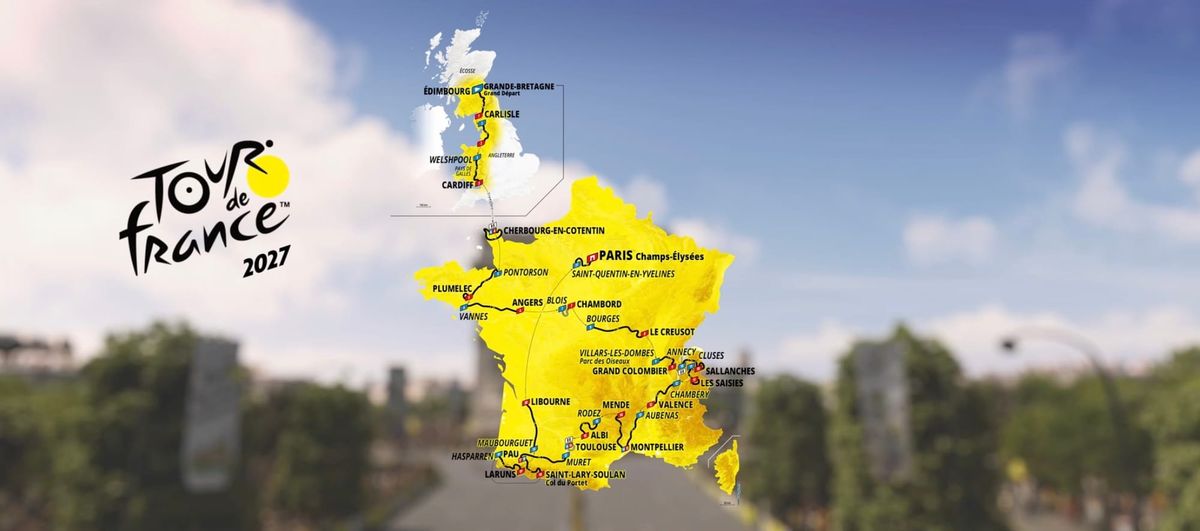
Bearing all this in mind, the route of the 2027 edition he unveiled in the Palais des Congrés in Paris is something akin to the greatest hits that Prudhomme has produced over the last 20 years with a couple of novelties for good measure. Before delving into those, though, the stand-out feature is the amount of individual time trialling. The tests at Château de Chambord and Toulouse add up to 70km (CHECK!!!), the highest distance since the 2012 race, which won by Bradley Wiggins, who claimed victory in both TTs that year.
Although defending champion Tadej Pogačar won’t be dismayed with this re-emphasis of time trial prowess given his supreme all-round ability in every type of terrain and discipline, 2026 Tour runner-up and world time trial champion Remco Evenepoel will be delighted with the prospect of more solo racing against the clock. The Chambord test could open the door to the yellow jersey for the Belgian. More pertinent, though, will be whether he’s still in the jersey or close to it when the Toulouse TT arrives at the start of the final week.
The race kicks off with a first visit to Scotland with a stage that finishes just over the English border at Carlisle that should suit the sprinters. Stage two takes in plenty of lumpy terrain on the road to Liverpool, offering a chance to breakaway hopefuls, while stage three brings a first visit to Wales, where a hilly Classic of a stage that should bring the GC favourites front and centre.
The stronger climbers among the sprinters should contest the finale of stage into Cherbourg on a day that’s always close to the coast and could bring the wind into play. Stage five’s finale with two ascents of the abrupt Cadoudal climb at Plumelec looks ideal for the hammer-blow punch of Mathieu van der Poel and, naturally, Pogačar.
Heading east towards the Alps, the sprinters should get another opportunity at Angers, 24 hours before the first of those two long time trials. The second weekend then serves up two very different climbing tests, the first of them through the Morvan massif, setting for a snorter of a stage in 2021 when a huge break shrugged off attempts by Pogačar and his UAE team to impose some control and Primož Roglič’s GC hopes turned to dust. That’s followed by the first summit finish of the race on the Grand Colombier, a regular feature under Prudhomme where Pogačar outsprinted Roglič for victory in 2020 and Michał Kwiatkowski won in 2023.
The two Alpine stages are designed to test the GC contenders, but without scattering them too severely. The first to Sallanches both tees up the following month’s World Championships in Haute Savoie and Bernard Hinault’s victory in the 1980 Worlds in that same town. The next day looks harder thanks to the linking of the very tough Pré and Bisanne passes before the finish in the resort of Les Saisies. The race then takes two steps towards the Mediterranean, with finishes in Valence and Montpellier that favour the sprinters.
Prudhomme and his route director Thierry Gouvenou didn’t unveil the Croix Neuve at Mende, but they’ve sent the race back there regularly knowing that the very lumpy approach to that super ramp will always serve up the spectacular. Coming in between stages to Montpellier and Albi that are good bets for bunch finishes, the 4,300 metres of vertical gain might even produce a big contest between the GC leaders, who usually hold back until they’re on the final ascent.
The final week begins with that longish Toulouse time trial that has a nasty little kick in its tail in the shape of the Pech-David climb where Jonas Abrahamsen and Mauro Schmid went head to head in 2025, the Norwegian edging the sprint between the pair in the “pink city”. It’s followed by the almost obligatory stage into Pau, this one for the sprinters as it was earlier this summer when Olav Kooij was the victor.
The two “judges of the peace”, as the French like to call the big mountain stages, bring out the best and very different sides of the Pyrenees. The first is a monstrous test finishing on the Col de Portet, which was the novelty at the other end of that F1-style start in 2018. To reach it the riders will cross the Soulor, the Tourmalet from Luz-Saint-Sauveur and the absolutely beautiful Hourquette d’Ancizan. The final climb is fearsomely steep both as it passes close to the resort of Pla d’Adet and then continues up to the majestic Portet pass, the high point of this race at 2,215 metres, a fitting culmination for what’s surely the “queen stage”.
The final day in the mountains is one that I’ve been waiting almost a quarter of a century to see and breaks new ground for Prudhomme and his organising team. The race has passed through the French Basque Country many times during that period, but has almost always bypassed the savagely sheer slopes of its higher passes. Two of them feature, the fearsomely stepping ascent of the Burdincurutcheta, not so much a stairway to heaven as a hellish ladder, and the shorter (from the western side) Bagargui. The Col de Soudet is a brute too, while the climbing ends on the shortish Col de Marie-Blanque, its final 4km averaging a far from sweet 10 per cent. If the weather plays ball, this stage will be stunning.
A transition stage to Libourne will take the race some of the way back towards Paris on the final Saturday, while the last Sunday will once again feature the cobbled ascent of La Butte Montmartre prior to the traditional finish on the Champs-Elysées.
While some may lament the lack of novelty for which Prudhomme has become renowned among these greatest hits, the route offers a good spread of opportunities to every type of rider. Tadej Pogačar will likely start as the favourite as he seeks a record-breaking sixth title and still looks like he has form and age on his side. It may be, though, that the big novelty of this race will be that it concludes with a French victor. Stronger and more seasoned after his Tour debut this summer, Paul Seixas will start as France’s brightest prospect seen during the Prudhomme era.