How the Tour de France Is Built, Filmed, and Run
A Circus On Wheels!

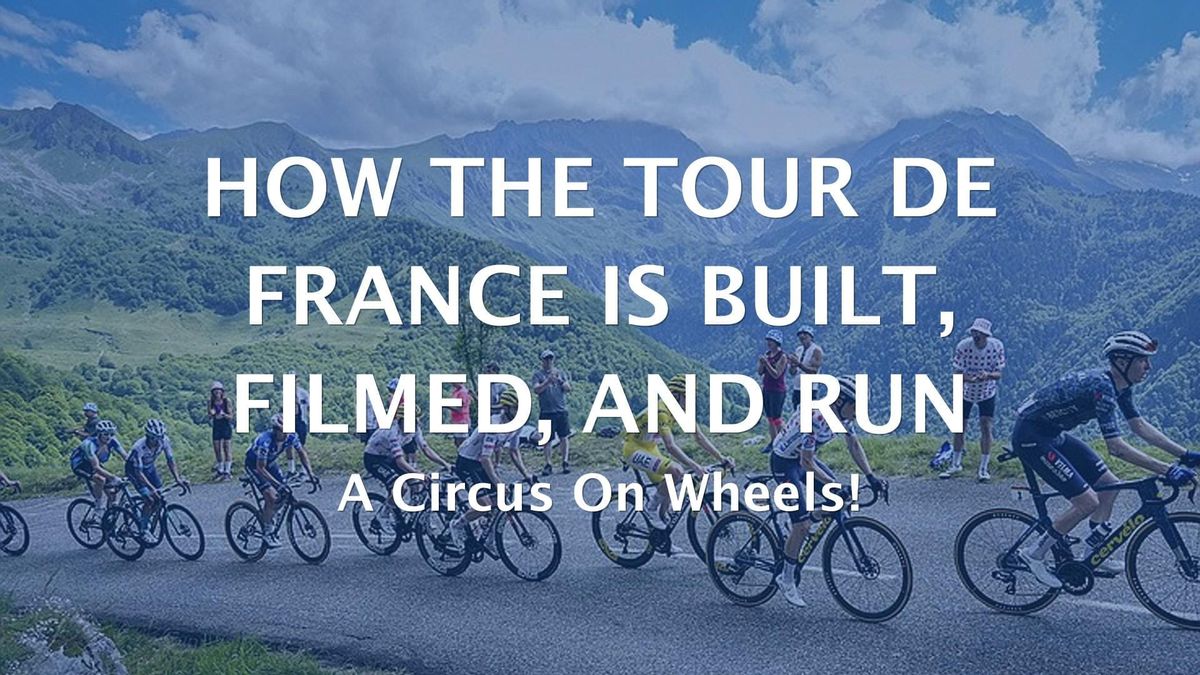
Watching the Tour de France from a couch makes it look effortless: five hours of helicopter shots gliding over châteaux while a breakaway hangs out front. But having worked on hundreds of races in my career, I know all to well what goes on behind the curtain. And that is just my experience with getting GPS devices on bikes and getting their signal from the bike to Tour Tracker’s servers and then to the user! It’s crazy.
So I thought I’d share what’s behind that curtain. As behind that calm picture sits one of the largest traveling outside-broadcast operations on Earth, a race route locked in years earlier, and a convoy of several thousand people that dismantles itself every evening and rebuilds the next morning a hundred miles down the road.
The route comes first — sometimes years first
Everything starts with the Amaury Sport Organisation (ASO), the private company that owns the Tour. A small full-time staff of around 70 — led by race director Christian Prudhomme and route director Thierry Gouvenou — designs each edition. Gouvenou’s team drives, surveys, and re-drives candidate roads, balancing sporting drama (summit finishes, time trials, crosswind country) against scenery, road quality, and the simple question of whether a town can physically host the circus.
It is also a business. Towns bid to host. A stage start or finish typically costs a French town somewhere around €100,000–150,000, while a foreign Grand Départ — the opening few days abroad — now runs to roughly €6 million. That is why recent Tours have launched from Copenhagen, Bilbao, Florence, and, in 2026, Barcelona. The route is finalised internally long before the public reveal each October; the host-broadcast and security teams often have eight months or more to prepare once the map is known.
The shape stays constant even as the roads change: 21 stages across 23 days, about 3,500 km total, alternating clockwise and counter-clockwise loops of France, traditionally finishing in Paris.
Start towns, finish towns, and the flag that doesn’t drop right away
Each stage town is essentially shut down and handed to the Tour for a day. Crews of contractors — ASO swells to a couple hundred staff plus around 500 contractors during the race — erect the start village, barriers, podium, and signage, then strike it all and leapfrog ahead overnight.
The start itself has two parts that confuse a lot of newcomers. The riders roll out from the official start line behind Prudhomme’s red car for a neutralised section through town — the départ fictif. The race isn’t actually on yet. Only when the convoy reaches kilometre zero on the open road does Prudhomme stand up through the sunroof and drop a white flag. That is the départ réel, the real start, and the moment the clock and the attacks truly begin.
When a breakaway becomes “official”
There is no single rule that flips a breakaway from “some riders up the road” to “the break of the day,” but there is a recognisable moment. After km 0, riders attack repeatedly until a group gets clear and — crucially — the peloton decides to let it go. Once the gap stabilises and starts to grow, Radio Tour (the race’s official information channel, broadcast to every team car and official) announces the composition of the group and the time gap. That announcement is effectively the break’s birth certificate: it’s now the move TV graphics will track and commissaires will manage.
Practically, “official” means the convoy reorganises around it. The race jury (the commissaires) opens the gap between the break and the peloton and admits vehicles into it in a fixed order — neutral support, then team cars for riders in the break, then TV and photo motos — so a five-rider escape suddenly has its own little procession of cars and motorcycles slotted in behind it.
The publicity caravan
Ahead of the riders by about an hour and a half rolls the caravane publicitaire, the gaudy sponsor parade that is, for many roadside French families, the real event. It sets off roughly two hours before the start, stretches 20–25 km along the road, and takes about 40 minutes to pass any given spot, hurling branded hats, sausages, and key rings to the crowd. Vehicles move in groups of five, are tracked by GPS and from the air, and are shepherded by a caravan director plus six motorcyclists from the elite Garde Républicaine. Brands pay around €150,000 to place three vehicles in it.
How many motorcycles, helicopters, and planes?
This is where the scale becomes absurd. France Télévisions is the host broadcaster, producing the “world feed” that every other network — NBC, ITV, your local channel — receives and re-commentates. The radio-frequency wizardry that gets pictures off a mountainside is handled by EMG / Gravity Media (the operation formerly known as Euro Media France).
In recent editions the live race pictures come from roughly six camera motorbikes carrying gyro-aware broadcast cameras, plus around seven journalist motorbikes (some with point-of-view cameras) for reporters slotting through the convoy. Add the security and officials’ motos — Garde Républicaine outriders, commissaire motorbikes, the photographers’ motos, the chalkboard ardoisier moto that still hand-writes time gaps — and the total number of motorcycles weaving around the peloton runs into the dozens.
Overhead, aviation specialist Hélicoptères de France flies multiple helicopters: two camera ships with gyro-stabilised systems for the action and the famous landscape shots, plus relay helicopters. Their signals can’t reach the finish directly over mountains, so the footage hops upward — to relay helicopters at altitude, then to two fixed-wing relay planes circling thousands of metres up, which beam it down to the technical zone at the finish.
On the ground, EMG runs three outside-broadcast trucks. The big one sits at the finish line gathering every feed; two smaller OB trucks are positioned as intermediate relay points along the route, scouted months in advance by people literally standing on hilltops with binoculars. The whole chain — moto camera to your screen — takes only about half a second.
At the finish itself, France Télévisions adds roughly 10–12 fibre-connected cameras for the sprint, the line, and the raw emotion afterward, with newer experiments in private 5G networks and on-bike POV feeds expanding what’s possible each year.
The circus that never stops
Tally it up and a single stage involves a 300-to-500-strong broadcast crew, dozens of motos, a fleet of helicopters and planes, hundreds of contractors, team cars, medical and neutral-support vehicles, thousands of police and gendarmes lining the route, and the sponsor caravan — then the entire operation packs into trucks at dusk, drives through the night, and resurrects itself somewhere new by morning. It does that 21 times in 23 days. The bike race, in the end, is the easy part.