
From a Jersey Pocket to the Cloud
A Short History of GPS Tracking in Pro Cycling

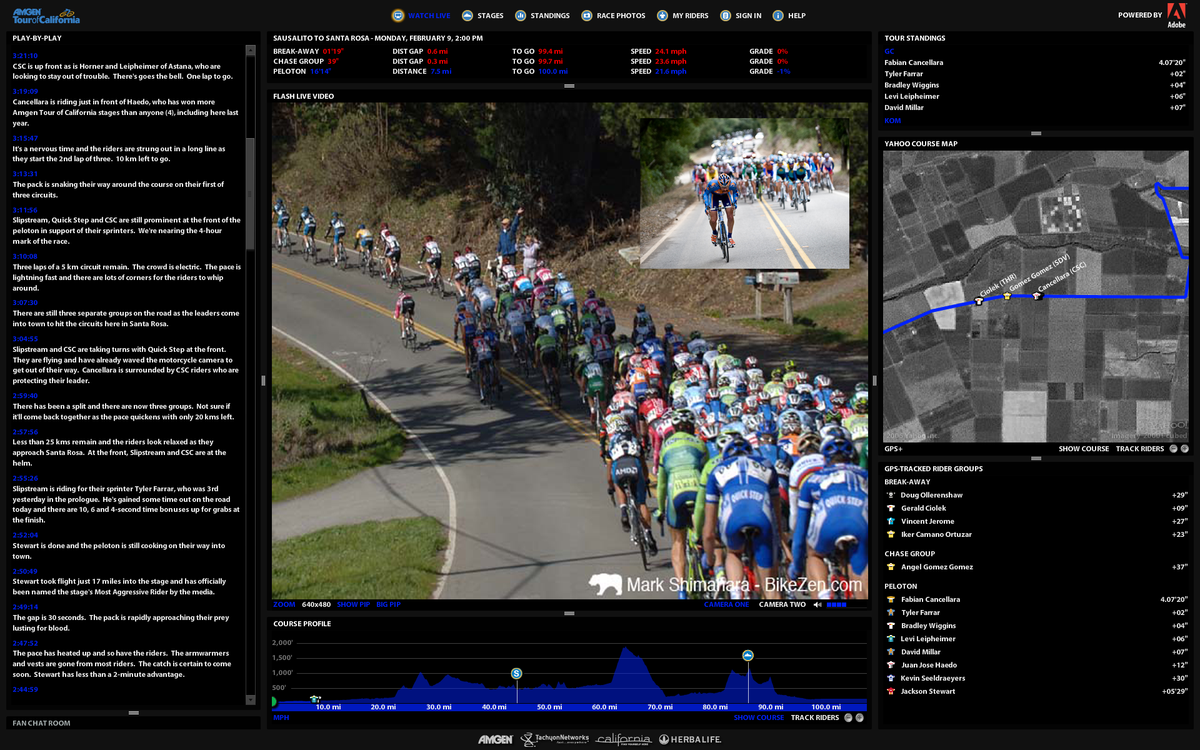
And yes, we are 100% giving ourselves props for being the first people to ever track a professional bike race!
For most of its history, professional cycling was strangely difficult to follow. The action could stretch across two hundred kilometres of mountain and farmland, and fans had to trust a television director and a few motorbike cameras to point them at the right moment. Time gaps were measured by stopwatch and chalkboard and radioed back to race headquarters. If a breakaway was out of shot, it simply didn’t exist on screen. The story of GPS tracking in cycling is the story of how that blind spot slowly disappeared — and it began earlier than most people realize.
The first dot on the map
The first live GPS tracking in a professional bike race happened at the 2007 Amgen Tour of California, built by the founder of Tour Tracker, then an engineer at Adobe. The Adobe Tour Tracker was, in effect, the world’s first digital cycling platform: it combined three things no one had ever bundled together — live streaming video, real-time GPS positions, and a running multimedia news feed — into a single web experience.
The mechanics were charmingly direct. Each day, the top ten riders carried a small GPS tracker tucked into a jersey pocket, and the application plotted their positions on a Yahoo! Maps layer alongside the race profile. As the system matured in the following years, the trackers moved onto the bikes themselves as cellular devices that phoned home to a server roughly once a minute, and the software converted those pings into distance travelled, speed, elevation, and gaps. On stage three that first year, fans watched a lone leader get reeled in barely fifty yards from the line in San Jose — the kind of drama that without a helicopter was only possible to watch unfold via the app.
Fun Fact: On the first day of coverage, Adobe’s internal network nearly collapsed with half of the company streaming live video all at once.
Adding watts to the picture
Tracking position was only the beginning. By the end of the decade, the same Tour Tracker platform was powering the SBS Tour de France coverage in Australia, and through a partnership with the German power-meter maker SRM, it began pulling live performance data — heart rate, cadence, and power — straight from riders inside the Tour de France peloton. For the first time, a fan at home could see not just where a rider was, but how hard he was actually pushing.
Not everyone in the bunch loved being watched. In one memorable moment, Levi Leipheimer tore the tracker off his bike mid-stage and hurled it to the roadside on live television. That tension — between fan transparency and rider privacy — became a recurring theme. The UCI eventually ruled that, for safety reasons, riders could not be individually tracked, which pushed early platforms back toward the group-based model the Tour de France itself would later adopt.
Other experiments bloomed in parallel. Quarq’s Race Intelligence and its Qollector unit brought live data to endurance and single-day events, proving the appetite for telemetry wasn’t limited to the Grand Tours. The pieces of a connected sport were falling into place; what was missing was someone with the money and the rights to wire up every rider at once.
The teams stake their claim
In 2014, eleven WorldTour teams — names like Sky, BMC, Movistar, Quick-Step, and the squad that is now UAE Team Emirates — banded together to form Velon, a London-based company designed to give the teams a commercial stake in their own data. Crucially, the teams contributed the right to mount electronic devices on their bikes during races, which gave Velon two products to build: on-bike cameras, and live rider data.
The data project made its proper debut at the 2016 Tour de Suisse, where a handful of riders, Fabian Cancellara and Peter Sagan among them, carried under-saddle units transmitting speed, power, and cadence to broadcasters in real time. Velon later expanded the offering into VelonLive with consulting partner EY, and today it remains owned by a core group of the sport’s biggest teams, supplying the graphics you see overlaid on race broadcasts and across social media.
The Tour goes digital
The watershed moment for mainstream fans arrived in 2015. Just weeks after Velon formed, Tour de France owner ASO struck its own five-year deal with the South African IT firm Dimension Data to track every single rider in the race — a first in the sport’s history. Each of the 198 starters had an 80-gram GPS transponder zip-tied beneath the saddle. Because much of rural France has no reliable cellular coverage, the system leaned on radio relays already used to carry television pictures: the under-saddle units talked to relays on the race motorbikes and cars, which beamed the signal up to aircraft overhead and down to a data truck at the finish.
It was rushed and imperfect — early in that first Tour, the system reliably caught around 170 of the 183 remaining riders, and it had to filter out transponders riding home on team-car roofs. But the scale was staggering: roughly 75 million GPS readings per Tour, accurate to within a few metres and snapped to the official route before reaching the public. Tellingly, ASO’s version carried no power or heart-rate data — the teams guarded those numbers as competitive secrets. When NTT later absorbed Dimension Data, the partnership continued under the NTT banner, and live rider tracking quietly became a permanent fixture of how the Tour is watched.
One might ask, however, what exactly does this bring to the cycling fan? Knowing the location of every rider is great for safety. It is a requirement for calculating gaps in real time between every rider. But does the average fan really want to see 180 small dots on a map? Does that really add to their watching experience? Analytics suggest that the average cycling fan focuses on the following things in order of frequency: live video, text commentary, tracking on a race profile, social media posts, and lastly, tracking on a race map.
What comes next
The newest chapter turns the technology back toward the riders’ own welfare. After the death of Gino Mäder at the 2023 Tour de Suisse, Velon built a safety layer on top of its data stream called the SAVE dashboard, which debuted at the 2025 men’s and women’s Tours de Suisse with every rider carrying a device. By watching for sudden decelerations or riders straying off-course, it can flag a likely crash and hand organisers exact coordinates within seconds. The UCI has been developing its own GPS safety system in parallel, tested at the Tour de Romandie Féminin, with the eventual aim of tracking every rider for safety as standard.
It is a long way from a single tracker in a jersey pocket on a California road in 2007. But the through-line is the same: turning the most beautifully chaotic sport in the world into something fans — and now the riders themselves — can finally see in full.