
Do Decathlon have their sights set beyond the Vuelta?

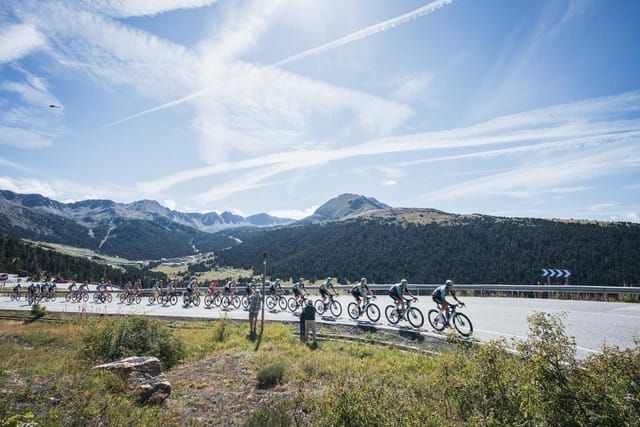
I’ve been intrigued by the tactics employed by Decathlon CMA CGM during the Vuelta a España, and indeed during the two previous Grand Tours this season. At all three, they’ve gone against tactical norms by deploying their domestiques to set the pace in the bunch at critical moments in the mountains even though they’ve not had the pre-eminent GC rider in their ranks.
Following the Vuelta’s Andorra stage, when the French team set a very rapid pace up the Envalira and then into the foot of the subsequent climb of the Beixalis, where Tadej Pogačar launched his stage-winning attack, Movistar’s Iván Romeo questioned their tactical logic. “Decathlon also made the race hard. I don’t know whether people watching at home understood it, because I found it a little difficult to understand myself,” said the Spaniard.
Romeo added that he wasn’t being critical, underlining that teams all have different reasons for riding on the front, but he admitted that he was mystified by Decathlon effectively doing the work of Pogačar’s UAE team for them. “It’s just a bit surprising when you see a team that’s so superior. I think it surprised all of us. We were talking about it in the group as well, but it’s their race,” he said.
Decathlon countered by saying that the climbs in Andorra suited their leader Felix Gall particularly well and they simply wanted to shake out or at least ramp up the pressure on the Austrian’s rivals for the podium spots below Pogačar. On stage 7 to Valdelinares, they employed the same tactic again, first battling with UAE for control at the front of the bunch, before getting Gregor Mühlberger and Matthew Riccitello to set a fast pace as a prelude to an attack from Gall. Only partly successful in the first instance, it worked better on the latter occasion, when the Austrian gained time on all of his direct GC rivals.
I wonder, though, whether there’s some other reason for these shows of force, with a more long-term goal in mind, specifically securing Paul Seixas within the Decathlon set-up.
Since the young Frenchman’s breakthrough among the elite in the early part of this season, there’s been endless debate and conjecture concerning his possible destination once his current contract runs out at the end of the 2027 season. UAE, Netcompany-Ineos, Visma-Lease a Bike and Pinarello Q36.5 have all been linked with Seixas, UAE very strongly.
Evidently, Decathlon are determined to keep him and can offer plenty of reasons for him doing so, including a French structure that comprises the country’s most popular brand and another backer that has annual revenues in excess of $50 billion and is owned by one of the world’s richest families.
But in order to convince Seixas to stay, the French team must also show that it can compete with the very best on the road, and these tactics play into this broader strategy. Mountain domestiques such as Mühlberger, Riccitello, Callum Scotson, Johannes Staune-Mittet, Tiesj Benoot, Nicolas Prodhomme, Aurélien Paret-Peintre, Léo Bisiaux, Sander De Pestel and Jordan Labrosse have shown their qualities on the climbs across this season’s three Grand Tours.
Equally, the likes of Oscar Chamberlain, Oliver Naesen, Rasmus Pedersen, Cees Bol and Daan Hoole have underlined that they have the qualities to protect a GC leader on flatter days and on shorter climbs.
Watching Decathlon perform so strongly in every aspect of racing, you can’t help wondering why Seixas would consider leaving a team that’s being built around him for one where he might have to share leadership with another GC big-hitter. More significantly, Seixas must be asking himself that same question.
Decathlon are giving Seixas every reason to stick with them for the long term, and this week’s announcement from UAE that they’re no longer in the hunt for the Frenchman’s signature suggests that this strategy is paying off.
– Peter Cossins