
2026 Tour de France Stage 18 Live Coverage

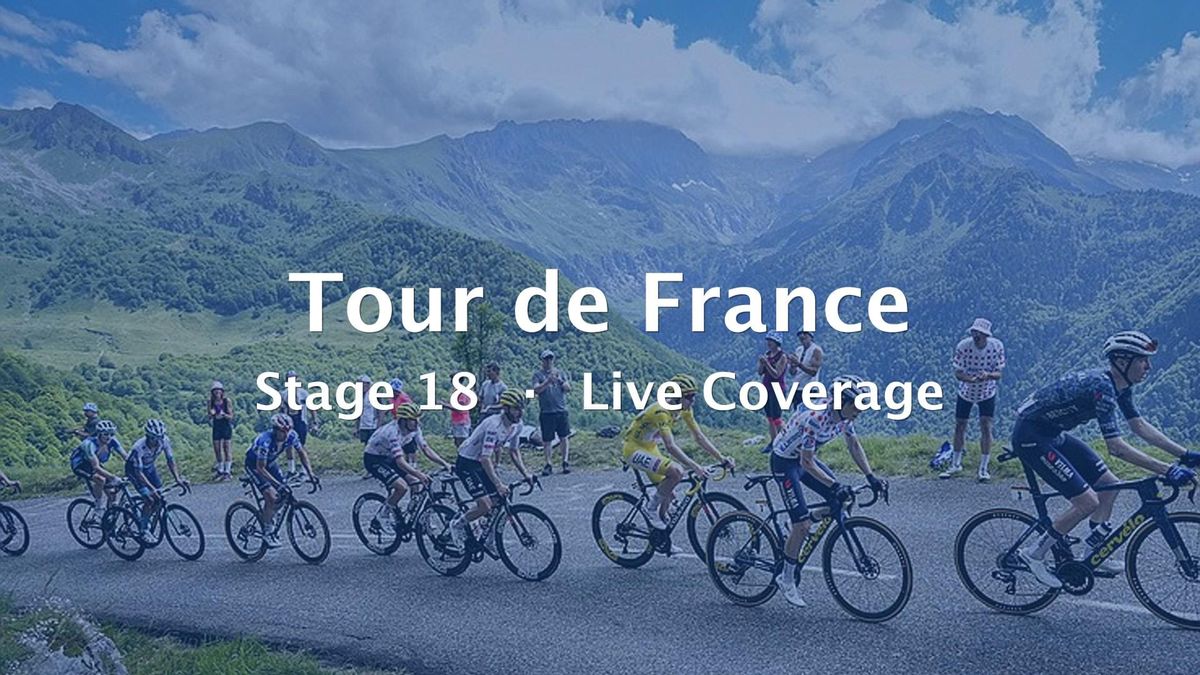
Welcome to our live coverage of Stage 18 of the 2026 Tour de France! Our live profile and commentary are below, followed by a preview of the technical aspects of the route.
Course Preview
Stage 18 of the Tour de France takes the race into the Alps. It's the first of three alpine stages, with 3,800 metres of elevation gain across 185 kilometres. The race finishes in the ski resort of Orcières-Merlette after a 7.1-kilometre ascent at an average gradient of 6.7%.
Six editions ago, the Tour last visited Orcières-Merlette. On that occasion, a group of around twenty riders sprinted for victory in the ski resort. Those were different times, with Primoz Roglic getting the better of Tadej Pogacar.
The riders set off from Voiron to head south towards Grenoble. Just before reaching the city, they turn right and tackle the climb to Engins: 11.4 kilometres at 5.4%. The climbing isn’t over in the village, though, as a long false flat continues all the way to Saint-Nizier-du-Moucherotte. From there, the route drops to the banks of the Drac River.
After roughly 10 kilometres in the valley, the route starts to climb again. The ascent to Monteynard is 9.7 kilometres long and averaging 5%. Again, there’s no real descent afterwards; instead, the course stays at around 900 metres altitude for some 55 kilometres, over constantly undulating terrain.
From La Fare-en-Champsaur onwards, with 32 kilometres remaining, the road rises almost continuously all the way to the line. Initially, at very shallow gradients, with the Côte de Saint-Léger-les-Mélèzes standing out as it rises at 6.8% for 2.8 kilometres. From that point on, the route is identical to 2020, so the finale is exactly the same as before.
Whether the outcome will be the same — a sprint from a reduced peloton — remains to be seen. Back then, it was stage 4, and many riders were still keeping their powder dry. This time, with only two mountain stages left after Orcières-Merlette, the race situation will be very different.
On the other hand, it could pan out the same way, as the final climb isn’t especially tough. The 7.1-kilometre ascent has an average gradient of 6.7% and is remarkably even.
Orcières-Merlette is best remembered for Luis Ocaña’s audacious attack in the 1971 Tour. After riding alone for 60 kilometres, he finished 9 minutes ahead of Eddy Merckx and Joop Zoetemelk. Ocaña would later crash out of the race, allowing Merckx to claim his third Tour de France title. Get more details at cyclingstage.com.
Get our full coverage of the Tour de France and every race we cover with our mobile app! The apps have over 100 additional exclusive features, including our award-winning Time Machine feature that lets you pause/rewind/replay the entire app to sync with delayed race video, integrated Fantasy Cycling, push notifications, an integrated news feed, live GPS tracking, world-class commentary, and our animated interactive maps and profiles.