
Getting Away With It: A History of Rule-Breaking at the Tour de France

The Tour de France has always been two races at once — the one on the road and the one against the rulebook. From its earliest editions, riders and teams have bent, dodged, and shattered the regulations, sometimes with impunity, sometimes to their ruin.
The chaos began almost immediately. The 1904 Tour, only the second ever held, nearly killed the event in its infancy. Riders climbed into cars, hitched tows, and caught trains between checkpoints. Fans blocked roads and beat rival riders to protect local favorites; someone scattered nails to shred tires. When the dust settled, organizers disqualified the top four finishers, including defending champion Maurice Garin. The title passed to nineteen-year-old Henri Cornet, still the youngest winner in history. Tour founder Henri Desgrange despaired that his race had been ruined by blind passion and villainy. It survived anyway.
If 1904 showed the punishment of cheats, 1913 showed the cruelty of the rules themselves. Eugène Christophe was descending the Tourmalet when his front fork snapped. Regulations forbade any outside assistance, so Christophe shouldered his bike, walked several miles to a blacksmith's forge in Sainte-Marie-de-Campan, and repaired the fork himself. Because a young boy pumped the bellows for him, officials handed Christophe a time penalty. He had followed the rules to the letter and still lost — a story cyclists tell to this day about the sport's unforgiving code.
Not every violation was so visible. The "sticky bottle" — where a rider grips a feed bottle handed from the team car a beat too long, catching a discreet tow uphill — has been quietly tolerated for generations. So has hidden drafting behind vehicles and the occasional sheltered feed. Commissaires fine these infractions when they are flagrant, but much of it disappears into the ordinary give-and-take of a race, a gray zone everyone acknowledges and few police.
Then there is doping, the shadow that has followed the Tour longest. In 1967, British rider Tom Simpson collapsed and died climbing Mont Ventoux with amphetamines in his system, a tragedy that forced the sport to confront what riders were putting in their bodies. It did not stop the practice. The 1998 Festina affair blew the door open when a team car was found stuffed with performance-enhancing drugs; the squad was expelled and the race nearly collapsed under a wave of police raids. The lowest point came later. Lance Armstrong won seven consecutive Tours from 1999 to 2005, dodging suspicion and testing for over a decade, before a U.S. Anti-Doping Agency investigation stripped every title in 2012 and exposed one of the most sophisticated doping programs in sports history. Floyd Landis lost his 2006 title the same way, undone by a positive test for testosterone just days after a legendary breakaway.
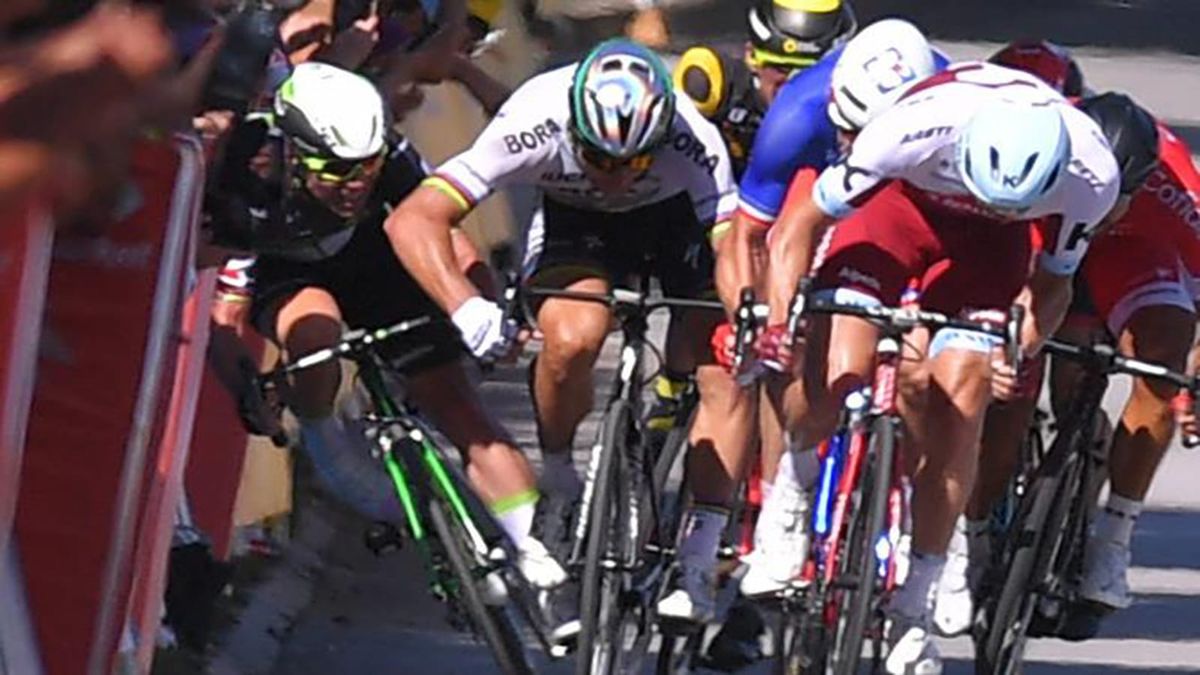
The modern era has its own suspicions and smaller sins. "Mechanical doping" — a hidden motor concealed inside the frame — moved from rumor to reality in 2016, when a motor was discovered in a rider's bike at the cyclocross world championships, confirming a fear that had long haunted road racing. The Tour now scans bikes with thermal cameras and X-rays. Meanwhile, the rulebook has grown fussier about smaller things: in recent years riders have been penalized for tossing bottles and wrappers outside designated litter zones, a nod to the environment that would have baffled the tow-hitching racers of 1904. Sprint finishes bring their own drama — Peter Sagan was disqualified from the 2017 Tour after a collision with Mark Cavendish, a decision so contested it fueled years of argument about how such incidents should be judged.
What emerges across more than a century is a simple truth: the Tour's rules have never been static, and neither has the ingenuity aimed at beating them. Some cheats were caught in the act and cast out on the spot. Some, like Armstrong, ran for years before the reckoning finally arrived. And some transgressions — the sticky bottle, the sheltered wheel, the too-friendly feed — remain woven into the fabric of the race, tolerated precisely because nearly everyone does them. The rulebook and the riders have been locked in the same long climb since 1903, and neither shows any sign of reaching the summit.